 Jason Finance
Binance Fees 2026: 0.1% Spot, 0.05% Futures, How the BNB Discount and a 20% Fee Rebate Stack, Why VIP 1 Keeps the Taker Fee, and USDT Withdrawal Fees

On this page
- 1.Binance fees at a glance: 0.1% spot and 0.02%/0.05% USDⓈ-M futures for regular users
- 1.1Paying fees in BNB: 25% off spot, 10% off USDⓈ-M futures
- 2.The 20% fee rebate: how it stacks with BNB and where it goes
- 2.1The official formula: based on the fees you actually pay
- 2.2Where it goes: spot as USDC, futures back to the futures account
- 2.3When it stops: two conditions in Binance’s rules
- 3.VIP 1 and VIP 2 don’t lower the taker fee: Binance VIP thresholds and fees
- 3.1The 2026 overhaul: assets alone can now get you VIP
- 3.2The VIP Level Protection Program after the hack: 3 November to 3 December
- 3.3Is VIP 1 worth it? The numbers for 10,000 USDT a month
- 4.USDC, FDUSD and zero-fee pairs: how much you save, and which get no rebate
- 4.1USDC pairs: only 5% off the taker fee, wiped out by a small move in the USDC price
- 4.2FDUSD pairs: no maker fee, full taker fee
- 4.3Pairs with no fees at all: no rebate, no BNB discount, no VIP volume
- 5.Buying the same 1,000 USDT of BTC, and trading 1,000 to 100,000 USDT a month: what you pay
- 5.1Buying 1,000 USDT of BTC: seven ways and what each costs
- 5.2Monthly cost of spot market (taker) orders
- 5.3Monthly cost of USDⓈ-M futures market (taker) orders
- 6.How to check your fee rate and that the fee rebate is working
- 7.Costs that are easy to miss: USDT withdrawal fees, Convert, card purchases and P2P
- 7.1USDT withdrawal fees: TRC20 up to 4 USDT after the hack
- 7.2Convert and the app’s Buy/Sell page: no fee, but no published maximum spread
- 7.3Buying crypto with a card, and P2P: the rate is on the checkout page
- 8.The fee rebate when you sign up for Binance with an invitation code
- FAQ
The short answer
Regular users pay 0.1% maker/taker on spot and 0.02%/0.05% on USDⓈ-M futures, like OKX and Bybit. Yet VIP 1 and 2 keep the 0.1% spot taker fee, and futures VIP 1 its 0.05%: no VIP saving on market orders. BNB cuts spot fees 25%; with a 20% fee rebate, spot takers pay about 0.06% (official formula). USDC pairs save only 5%, zero-fee pairs get no rebate, and post-hack TRC20 withdrawals cost 4 USDT.
Suits
- People who buy and sell spot with market orders, trade a few thousand to a few tens of thousands of USDT a month, and are willing to hold a little BNB to pay fees
- People who often move USDT on low-fee networks such as BEP20 and Polygon
- People with close to US$100,000 in assets who mostly use limit orders that rest on the book: VIP 1 only lowers the maker fee
Doesn't suit
- People who don't want to hold BNB: the BNB discount and every VIP tier require holding BNB
- People who often make small TRC20 withdrawals: since the hack, 4 USDT each, with a 10 USDT minimum
- People hoping to save on fees with USDC pairs: Binance takes off only 5%, while Bybit gives 50% off
What would change this verdict
- Binance changes regular-user fees, VIP thresholds or the BNB discount
- Withdrawal networks paused after the hack reopen, or withdrawal fees change again
- The taker fee promotion on USDC pairs ends or changes
Disclosure: this page contains exchange invitation links and codes. If you sign up through them, the exchange may pay Jason Finance a referral commission. It does not raise the fees you pay; the invitation fee rebate is set by the exchange. Our ratings follow the published methodology, where the invitation rebate counts only toward the fees item.
Binance fees come down to five things: regular-user maker and taker rates, the discount for paying fees in BNB, VIP thresholds, the fee rebate you get by signing up with an invitation code, and special pairs such as USDC and FDUSD, plus withdrawal fees. This article is based on Binance’s official fee pages, announcements and help center as of 4 November 2026, and works out what you actually pay to buy the same 1,000 USDT of BTC, or to trade 1,000 to 100,000 USDT a month.
Three results set Binance apart from other exchanges. First, Binance VIP 1 and VIP 2 still pay a 0.1% spot taker fee, and on USDⓈ-M futures, VIP 1’s taker fee is the same 0.05% as a regular user’s. If you only use market orders, moving up to VIP 1 saves you nothing, while a 20% fee rebate cuts what you pay by 20% straight away. Second, the BNB discount and the 20% rebate can be used together: working from the formula Binance has published, a spot taker trade with BNB turned on costs about 0.06%. Third, USDC pairs on Binance take only 5% off the taker fee (0.095%), unlike Bybit’s 50% off; pairs with no fees at all get no fee rebate and no BNB discount, and their volume does not count toward VIP.
On 29 October 2026, about US$6.3 billion was stolen from Binance’s hot wallets. Withdrawals have been resuming in stages since 1 November; as of 4 November, many USDT networks still could not be used for withdrawals, and the TRC20 withdrawal fee had gone up (see the section on withdrawal fees below). For what happened, see “Binance hack”.
This article is a summary of information, not investment advice. The fees here are figures taken from Binance’s official fee pages, announcements, help center and public data on 4 November 2026. They change, so check Binance’s current pages before you trade. This article covers Binance’s global site, and all futures fees are for USDⓈ-M futures. This site does not give advice on futures or leveraged trading; futures fees are listed only so readers can compare costs.
Binance key factsData checked: 2026-10-08
As of 2026-10-08, Binance's general-user spot taker fee is 0.1% and its futures taker fee is 0.05%; signing up with the invitation code gives a 20% trading fee rebate. Its 2026-11-04 proof of reserves showed BTC 100.03%, ETH 100.02%, USDT 101.55%.
| Item | Details | Source |
|---|---|---|
| Jason Finance rating | 64.3 / 100 | rating method |
| Highlights | Among the deepest BTC and ETH order books zk-SNARK proof of reserves 2023 US guilty plea | |
| General-user fees (taker) | Spot 0.1%, futures 0.05% | 2026-10-08 |
| Invitation code fee rebate | 20% trading fee rebate | 2026-10-31 |
| Proof of reserves | 2026-11-04 (monthly): BTC 100.03%, ETH 100.02%, USDT 101.55% | 2026-11-06 |
| Main licences and registrations | Abu Dhabi FSRA licence, Dubai VARA licence, Bahrain CBB licence, Japan FSA registration (Binance Japan) | source 1 source 2 source 3 source 4 |
| USDT withdrawals | Cheapest BEP20 0.01 USDT; 2 common networks supported | 2026-11-01 |
| Order book depth (±2%) | BTC/USDT about 23.8M USD, ETH/USDT about 17.9M USD | 2026-10-08 |
Binance fees at a glance: 0.1% spot and 0.02%/0.05% USDⓈ-M futures for regular users
Regular-user fees on Binance’s “Spot Trading Fee Rate” page and in “Binance Futures Fee Structure & Fee Calculations” (updated 1 May 2026), checked on 4 November 2026:
| Trading type | Maker | Taker | Paying fees in BNB |
|---|---|---|---|
| Spot and margin (standard pairs) | 0.1% | 0.1% | 25% off: 0.075%/0.075% |
| Spot USDC pairs | Standard rate for your tier (0.1% for regular users) | 0.095% | Taker 0.07125% |
| Selected FDUSD pairs (such as BTC/FDUSD) | 0% | 0.1% (standard rate) | 25% off taker |
| USDⓈ-M futures | 0.02% | 0.05% | 10% off: 0.018%/0.045% |
- Maker or taker depends on how the order fills: the futures FAQ says “Market Orders are always taker trades”; a limit order only counts as a maker order if it goes onto the order book and fills later. To make sure you pay the maker rate, see “A limit order is not always a maker order: how Post-only makes sure you pay the maker fee”.
- Spot fees come out of the asset you receive: “How to Calculate Binance Spot Trading Fees?” says “Trading fees are always charged in the asset you receive”: when you buy BTC, the fee comes out of the BTC you get; when you sell, it comes out of the USDT you receive. With the BNB discount turned on, it comes out of your BNB instead.
- Futures fees are based on position value, not leverage: the formula is “Trading Fee = Position Value * trading fee”, where position value is the contract size times the execution price. Binance’s example is a market buy of 1 BTC of futures at 10,104, with a taker fee of 10,104 × 0.05% = 5.052 USDT; closing it later with a limit order is charged again at the maker rate.
- The estimated fee on the trading page is only an estimate: for what you were actually charged, check “Trade History” (see the section on checking below).
Paying fees in BNB: 25% off spot, 10% off USDⓈ-M futures
Binance’s “How to Use BNB to Pay for Fees and Earn up to 25% Discount?” (updated 6 February 2026) says: “You can save up to 25% on Spot and Margin trading fees and up to 10% on Futures trading fees.” The conditions:
- On spot, you have to turn it on yourself: on the website, click [Fee Level] on the spot trading page and switch on the BNB discount; in the app, go to [Account Center], tap the [Settings] icon in the top right corner, tap [BNB Discount] and turn on [Use BNB to pay fees]. You need enough BNB in your spot wallet.
- On USDⓈ-M futures, you have to move BNB into the futures wallet: “Binance Futures Fee Structure & Fee Calculations” says that if there is not enough BNB in your USDⓈ-M futures wallet, the system deducts USDT instead, and that trade gets no discount.
- Not enough BNB means the full fee: the same goes for spot; if your BNB balance runs short, you pay the original rate.
- It stacks with VIP: the fee page lists a “paying in BNB” rate for every VIP tier, which is the VIP rate with 25% off; for example, VIP 3’s 0.06% spot taker fee becomes 0.045%.
- The trading page does not show a BNB amount: Binance explains that the system does not yet know the filled amount when you place the order, so the estimated fee is shown only in the coin you receive.
BNB’s price goes up and down. If you hold BNB to save on fees, what you save may not make up for a fall in BNB’s price; for how to work it out, see “Are platform token fee rebates worth it?”.
The 20% fee rebate: how it stacks with BNB and where it goes
Sign up for Binance with this site’s invitation code and you get a 20% trading fee rebate, the same for spot and futures; the rate comes from the data synced daily for the invitation box below. Binance’s “Binance Affiliate Program Starter Guide” (updated 4 November 2026) says the invitee’s fee rebate is up to 20%, applies to spot, margin and futures, and is set by the inviter. The rebate is paid afterwards: you pay the full rate when the trade fills, and the rebate is then returned to your account.
The official formula: based on the fees you actually pay
Binance’s “Important Update to Binance Referral Commission” (updated 29 May 2026) says that from 29 April 2026 for spot and from 15 July for futures, all referral program payouts are calculated with this formula:
Commission = Net Fees × Commission Rate
Net fees are defined as “transactional income after deducting any applicable market maker rebates”. So the amount returned follows the fees you actually paid; when your order fills against a market maker’s order, the net fee may be slightly less than what you paid, and Binance has not published the rates involved.
Binance does not spell out how this works once the BNB discount is on. Under the formula, what comes back is 20% of the fee you actually paid. The table shows regular-user rates this site worked out from the formula:
| Regular user | Charged when filled | 20% returned | Real cost | Less than the full rate |
|---|---|---|---|---|
| Spot taker, BNB off | 0.1% | 0.02% | 0.08% | 20% |
| Spot taker, BNB on | 0.075% | 0.015% | 0.06% | 40% |
| USDⓈ-M futures taker, BNB off | 0.05% | 0.01% | 0.04% | 20% |
| USDⓈ-M futures taker, BNB on | 0.045% | 0.009% | 0.036% | 28% |
When you see “Binance invitation code 40%” online, it is usually the second row of this table: 25% of it is the BNB discount Binance gives every user, which you get without an invitation code, and the invitation code itself gives at most 20%. I checked Binance invitation codes found online myself; the results are in “Binance invitation code”.
Where it goes: spot as USDC, futures back to the futures account
- Spot and margin: under Binance’s “Important Updates on Binance Referral Program (2025-02-13)”, since 13 February 2025 the returned fees have been calculated every hour, converted to USDC and deposited into the spot account within 6 hours of being generated. Binance’s example is that trades made between 14:00 and 15:00 are credited by 21:00 the same day. Invitees can see them under [Share Commissions] on the referral page. A single payout worth less than 0.00000001 USDC after conversion is not paid.
- Futures: according to my own account records, the fees returned on futures trades go back to the futures account, not the spot account. Futures are also missing from the list of products covered in the announcement above.
- Seeing the full rate in your trade details is normal: the fee shown in “Trade History” is the original rate. That does not mean the rebate failed; check where the rebate is paid.
When it stops: two conditions in Binance’s rules
Under the official rules in “Frequently Asked Questions on Binance Referral Pro Mode” (updated 5 August 2026):
- Spot: once the invitee reaches VIP 3 or higher, the spot fee rebate stops.
- Futures: the futures rebate has a 1-year validity period and stops when it expires (except in the cases Binance’s rules provide for).
In other words, as long as you don’t reach VIP 3, the spot fee rebate keeps going. The invitation code has to be entered when you sign up; if you didn’t enter one, Binance’s official ways to add one are covered in “How to change or add a Binance referral code after sign-up”.
Binance is an international exchange. The rate, invitation code and sign-up screenshot in the box below come from data synced daily. Sign up with this site’s invitation code and you get a 20% trading fee rebate, the same for spot and futures:
VIP 1 and VIP 2 don’t lower the taker fee: Binance VIP thresholds and fees
Every Binance VIP tier requires holding BNB. According to the 18 March 2026 announcement “Binance Updates VIP Program Eligibility Thresholds” (updated 10 September) and the VIP page, the thresholds for VIP 1 to VIP 3 are (in US dollars):
| Tier | BNB held | 30-day spot volume | 30-day futures volume | Assets |
|---|---|---|---|---|
| VIP 1 | 5 | 1 million | 5 million | 100,000 |
| VIP 2 | 25 | 5 million | 10 million | 200,000 |
| VIP 3 | 100 | 20 million | 50 million | 1 million |
Fees by tier (spot from the official fee page; USDⓈ-M futures VIP 1 to 3 from the March announcement):
| Tier | Spot maker/taker | Spot paying in BNB | USDⓈ-M futures maker/taker |
|---|---|---|---|
| Regular | 0.1%/0.1% | 0.075%/0.075% | 0.02%/0.05% |
| VIP 1 | 0.09%/0.1% | 0.0675%/0.075% | 0.018%/0.05% |
| VIP 2 | 0.08%/0.1% | 0.06%/0.075% | 0.016%/0.04% |
| VIP 3 | 0.04%/0.06% | 0.03%/0.045% | 0.012%/0.032% |
- Spot VIP 1 and VIP 2 only lower the maker fee: the taker fee is the same 0.1% as for regular users, and only drops to 0.06% at VIP 3. USDC pairs work the same way: regular users, VIP 1 and VIP 2 all pay a 0.095% taker fee.
- Futures VIP 1’s taker fee has not been lower since the March overhaul either: the March announcement cut VIP 1’s futures volume threshold from US$15 million to US$5 million and, at the same time, changed VIP 1’s USDT futures fees from 0.04% taker/0.016% maker to 0.05%/0.018%. In the announcement’s words, “VIP 1-2 trading fees have been slightly adjusted”.
- Spot VIP 4 to VIP 9 thresholds and fees are on the official fee page and won’t matter to most readers; for futures fees at VIP 4 and above, go by Binance’s official futures fee page.
This is where Binance differs from OKX and Bybit. The OKX and Bybit figures below are the official fees gathered in this site’s “OKX fees” (31 October) and “Bybit fees” (2 November):
| Exchange | Regular spot taker | VIP 1 spot taker | VIP 1 asset threshold |
|---|---|---|---|
| Binance | 0.1% | 0.1% (no change) | US$100,000 + 5 BNB |
| OKX | 0.1% | 0.08% | US$100,000 |
| Bybit | 0.1% | 0.08% | US$100,000 |
Regular-user fees at other exchanges are in the international exchange fee comparison.
The 2026 overhaul: assets alone can now get you VIP
The “New VIP Holder Program” in the March announcement took effect at 07:59 Taipei time (UTC+8) on 21 March 2026 and cut the asset thresholds sharply:
- Asset thresholds: VIP 1 fell from US$500,000 in assets to US$100,000, and from 25 BNB to 5; VIP 2 is US$200,000 + 25 BNB; VIP 3 has been US$1 million + 100 BNB since 21 July 2026.
- BNB also counts toward assets: the announcement says “BNB holdings will now count toward both overall asset calculations and the BNB holding requirement”, and assets cover spot, futures, funding, Earn and Alpha. So the US$100,000 can include those 5 BNB; at about 719 USDT per BNB on 4 November 2026, 5 BNB is about 3,597 USDT.
- Assets are the higher of two figures: average net assets are “the higher of the 30-day average net assets or the previous day’s net assets”.
- Updated once a day: “VIP levels are updated daily at 08:00 (UTC) based on the applicable requirements. If you qualify under multiple criteria, your VIP level will reflect the highest level you meet.” Besides trading volume and assets, the announcement also says you can qualify for VIP through borrowing.
- Whether the futures volume route needs BNB: the announcement says the BNB requirement change “applies to all VIP programs”, but the table on the VIP page only pairs BNB with spot volume, and Binance has not made this clear.
The VIP Level Protection Program after the hack: 3 November to 3 December
Binance’s 2 November 2026 announcement “Binance VIP Level Protection Program”:
- Who it covers: users who reached any tier from VIP 1 to VIP 9 between 08:00 on 21 October and 07:59 on 31 October 2026 (Taipei time); the highest tier in that period becomes their “protected level”.
- How long: for the 30 days from 08:00 on 3 November to 07:59 on 3 December (Taipei time), your tier will not fall below the protected level even if you don’t meet the usual VIP requirements; moving up to a higher tier during this time is not affected.
- One time only: standard VIP rules apply again from 08:00 on 3 December. Only users who have completed identity verification are eligible.
The program mainly matters to VIP users who moved assets out or traded less after the hack; regular users are not affected.
Is VIP 1 worth it? The numbers for 10,000 USDT a month
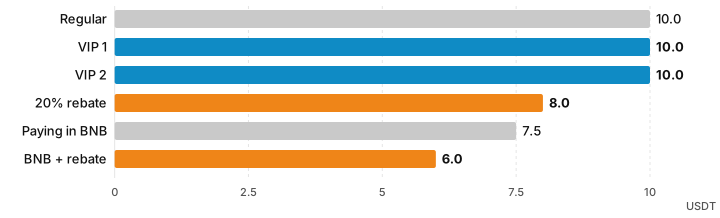
For 10,000 USDT of spot trading a month:
- Market orders only: VIP 1 and VIP 2 both pay 10 USDT, the same as a regular user, saving nothing each month.
- Limit orders that rest on the book only: VIP 1’s maker fee is 0.09%, so you pay 9 USDT a month, 1 USDT less than a regular user.
- For comparison: with the same market orders, a 20% fee rebate saves 2 USDT a month; the BNB discount saves 2.5 USDT; using both saves 4 USDT, working from the formula.
Here are a regular user’s real rates after a 20% fee rebate next to VIP 1 and VIP 2 (calculated by this site from the official fees):
| Fee | Regular | Regular + 20% rebate | VIP 1 | VIP 2 |
|---|---|---|---|---|
| Spot maker | 0.1% | 0.08% | 0.09% | 0.08% |
| Spot taker | 0.1% | 0.08% | 0.1% | 0.1% |
| USDⓈ-M futures maker | 0.02% | 0.016% | 0.018% | 0.016% |
| USDⓈ-M futures taker | 0.05% | 0.04% | 0.05% | 0.04% |
With a 20% fee rebate, a regular user’s real rate on all four is equal to or lower than VIP 2’s, and VIP 2 requires US$200,000 in assets plus 25 BNB (about 17,984 USDT of BNB on 4 November). If you are already VIP 1 or VIP 2, the fee rebate still applies: VIP 2 with BNB on and a 20% rebate pays 0.075% × 0.8 = 0.06% as a spot taker, the same as VIP 3’s taker fee without BNB. At VIP 3, under Binance’s rules, the spot fee rebate stops.
Putting US$100,000 on an exchange for VIP 1 gets someone who only uses market orders no lower rate, and they also take on the risk of the exchange itself.
USDC, FDUSD and zero-fee pairs: how much you save, and which get no rebate
USDC pairs: only 5% off the taker fee, wiped out by a small move in the USDC price
Binance’s “Binance Introduces Taker Fee Promotion for USDC Spot and Margin Trading Pairs” says that “Starting from 2024-04-10 00:00 (UTC) until further notice”, USDC spot and margin pairs get a taker fee discount: regular users, VIP 1 and VIP 2 pay a 0.095% taker fee (0.07125% paying in BNB), and VIP 3 pays 0.055%; maker fees are the standard rate for your VIP tier. The announcement also notes: “Zero maker and taker fees will apply to the USDC/USDT trading pair.” Binance’s new trading pair announcement on 22 December 2025 still said the promotion continues until further notice.
0.095% is only 5% less than 0.1%. On Bybit, USDC pairs get 50% off taker fees (0.05% on spot), so this works on Bybit but saves very little on Binance. Using Binance’s order book at 16:20 (UTC) on 4 November 2026, buying 1,000 USDT of BTC:
- USDC/USDT best ask 1.00084: 1,000 USDT buys about 999.16 USDC (this pair has no fee).
- BTC/USDC best ask 80,615.60, about 80,683.32 in USDT, almost exactly the BTC/USDT best ask of 80,683.47.
- So going through USDC only saves the difference in fees: 1,000 × (0.1% − 0.095%) = 0.05 USDT. If the USDC/USDT price moves just 0.005% further against you (0.00005 USDT per USDC), that 0.05 USDT is gone.
For how USDC and USDT differ, see “USDT vs USDC”.
FDUSD pairs: no maker fee, full taker fee
Binance’s “Binance Updates the Zero Trading Fee Promotion for All Users (2026-01-29)” (15 January 2026) says that from 08:00 Taipei time on 29 January 2026, “standard taker fees will apply to all users” on BTC/FDUSD, BNB/FDUSD, DOGE/FDUSD, ETH/FDUSD, LINK/FDUSD, SOL/FDUSD and XRP/FDUSD, and “Zero Maker fee will remain as it is for the aforementioned pairs.” The same announcement says these pairs’ volume counts toward VIP tier volume, and the Chinese version of the announcement adds:
All of the above spot and margin trading pairs will take part in all users’ BNB fee discounts, fee rebates and any other form of fee adjustment or fee promotion
Three things to watch in practice:
- No maker fee means no fee to rebate: the 20% rebate is based on the fee you actually pay, and 20% of 0 is still 0. Taker trades pay the standard rate, and the rebate and BNB discount apply as usual.
- A limit order that rests on the book may not fill: if the price moves away, you have to change the price or switch to a market order.
- You have to convert USDT to FDUSD first: on 4 November 2026, FDUSD/USDT was 0.9984 bid and 0.9986 ask, not exactly 1. FDUSD is a stablecoin issued by a different company, and you need to judge the risk of holding it yourself.
Binance’s promotional trading pairs page also lists a 0% maker fee on many other FDUSD pairs, such as ADA and AVAX; you can check it there before placing an order.
Pairs with no fees at all: no rebate, no BNB discount, no VIP volume
Pairs with 0% maker and taker fees, such as USDC/USDT and FDUSD/USDT, follow different rules. According to the notes on the promotional trading pairs page, their volume does not count toward VIP tier volume, and the BNB discount, referral fee rebates and other adjustments do not apply; only pairs with just a 0% maker fee (such as the FDUSD pairs above) still count.
So converting back and forth on USDC/USDT does not build up VIP volume, and there is no fee to rebate.
Buying the same 1,000 USDT of BTC, and trading 1,000 to 100,000 USDT a month: what you pay
Buying 1,000 USDT of BTC: seven ways and what each costs
Calculated for a regular user with the order book at 16:20 (UTC) on 4 November 2026 (BTC/USDT best ask 80,683.47, BNB 719.34 USDT):
| Method | Rate | Fee | Notes |
|---|---|---|---|
| BTC/USDT market order | 0.1% | 1 USDT equivalent | About 0.0000124 BTC, taken from the BTC you buy |
| BNB discount on | 0.075% | 0.75 USDT equivalent | About 0.00104 BNB, taken from your BNB |
| 20% fee rebate (BNB off) | 0.1% charged first | 0.8 USDT net | 0.2 USDT converted to USDC and returned to your spot account within 6 hours |
| BNB discount + 20% rebate | 0.075% charged first | 0.6 USDT net | Worked out by this site from the official formula |
| BTC/USDC market order | 0.095% | 0.95 USDT | 0.7125 with BNB, about 0.57 after the 20% rebate; you need USDC first, and the spread is extra |
| BTC/FDUSD limit order on the book | 0% | 0 | May not fill; you need FDUSD first; no rebate to get |
| Convert | No fee | Built into the quote | Binance has not published a maximum spread (see below) |
Monthly cost of spot market (taker) orders
“Monthly trading amount” is buys and sells added together; for example, buying 5,000 USDT and then selling it is 10,000 USDT. 100,000 USDT a month does not reach the VIP volume threshold, so the VIP 1 and VIP 2 column assumes the tier was reached through assets.
| Monthly trading amount | Regular 0.1% | VIP 1, VIP 2 0.1% | After 20% rebate 0.08% | Paying in BNB 0.075% | BNB + rebate 0.06% |
|---|---|---|---|---|---|
| 1,000 USDT | 1 | 1 | 0.8 | 0.75 | 0.6 |
| 10,000 USDT | 10 | 10 | 8 | 7.5 | 6 |
| 100,000 USDT | 100 | 100 | 80 | 75 | 60 |
Figures in USDT. At 10,000 USDT a month, a year comes to 120 USDT for a regular user, 96 USDT with the rebate and 72 USDT with BNB plus the rebate.
Monthly cost of USDⓈ-M futures market (taker) orders
Futures fees are based on the value of the position traded, not the margin.
| Monthly trading amount | Regular 0.05% | VIP 1 0.05% | After 20% rebate 0.04% | Paying in BNB 0.045% | BNB + rebate 0.036% |
|---|---|---|---|---|---|
| 1,000 USDT | 0.5 | 0.5 | 0.4 | 0.45 | 0.36 |
| 10,000 USDT | 5 | 5 | 4 | 4.5 | 3.6 |
| 100,000 USDT | 50 | 50 | 40 | 45 | 36 |
- The two “BNB + rebate” columns were worked out by this site from the official formula; changes in BNB’s price are not included.
- The tables count fees only. Large market orders also have slippage, and futures also have funding fees.
- To work it out with your own volume and maker/taker mix, use the calculator below.
Handy tool
Want to know what your monthly trading volume costs in fees at each exchange? Enter your amount and how you trade to compare official rates with your cost after the fee rebate.
Start calculatingHow to check your fee rate and that the fee rebate is working
Binance’s fee rebate is paid afterwards, so if you only look at your trade details, it looks as if you got no rebate. Check your account in this order; the paths come from Binance’s help center and announcements, and names may differ slightly after app updates:
- Check your tier and rates: on the website, go to “Fees & Transactions Overview” (you need to log in); in the app, go to “My VIP”. This shows the standard rates for your tier, without the fee rebate.
- Check that the BNB discount is on: see the section on paying fees in BNB above for where to find it. For USDⓈ-M futures, you also have to move BNB into the futures wallet.
- See what each trade was charged: go to “Trade History” to see the fee on each trade; with the BNB discount on, it is shown in BNB. Check whether it equals “trade amount × your rate”.
- Find the returned rebate: for spot, look for the USDC credits under [Share Commissions] on the referral page (on the website, “Profile” → “Referral”; in the app, “Referral” on the home screen); records older than 7 days can only be seen by downloading the details. For futures, look in the futures account’s records.
- Check the referral relationship and rate: the “Referral Relationship” on the referral page shows the rate linked to your account; for how to read it, see “Binance invitation code”.
Take a regular user’s 1,000 USDT market buy of BTC: with BNB off, Trade History shows a fee of about 0.0000124 BTC (1 USDT equivalent), and under the formula, about 0.2 USDT in USDC should appear under [Share Commissions] within 6 hours; with BNB on, the fee is about 0.00104 BNB (0.75 USDT equivalent), and about 0.15 USDT comes back. Both returned amounts were worked out by this site from the official formula; your account is what counts.
Costs that are easy to miss: USDT withdrawal fees, Convert, card purchases and P2P
USDT withdrawal fees: TRC20 up to 4 USDT after the hack
According to Binance’s crypto deposit and withdrawal fees page, deposits are free; each withdrawal pays a fixed fee that depends on the blockchain network, and the latest figures on the withdrawal page are what count. USDT networks in Binance’s official withdrawal data on 4 November 2026 (UTC):
| Network | Withdrawal fee (USDT) | Minimum withdrawal (USDT) | This site’s record on 23 October |
|---|---|---|---|
| BEP20 | 0.01 | 5 | 0.01/5 |
| Polygon | 0.03 | 3 | 0.03/3 |
| Optimism | 0.04 | 3 | No record |
| AVAX C-Chain | 0.04 | 5 | No record |
| Arbitrum One | 0.3 | 3 | 0.3/3 |
| TON | 0.3 | 3 | 0.3/3 |
| ERC20 | 0.6 | 5 | 0.6/3 |
| TRC20 | 4 | 10 | 1.5/5 |
- TRC20 went up from 1.5 to 4 USDT, and the minimum withdrawal from 5 to 10 USDT: Binance’s recovery announcements after the hack do not mention any change to withdrawal fees, the official page only says fees depend on the network, and Binance has not publicly explained the reason for the change.
- Many networks still can’t be used for withdrawals: in the same data, USDT withdrawals on Solana are halted, which Binance says is because it is replenishing the hot wallet; Plasma, opBNB, NEAR, Aptos, Celo, Kaia, Scroll, Tezos and other networks show wallet maintenance. Before withdrawing, check on the withdrawal page that the network is open.
- On small withdrawals, the withdrawal fee costs far more than the trading fee: withdrawing 100 USDT on TRC20, the 4 USDT fee is 4%, 40 times the spot taker fee on 100 USDT (0.1 USDT); on BEP20 it is only 0.01 USDT.
- Before choosing a network, make sure the receiving side supports the same one; for how to choose, see “How to choose a USDT withdrawal network”.
Convert and the app’s Buy/Sell page: no fee, but no published maximum spread
Binance’s Convert FAQ says Convert charges no fee and has no costs other than the quote, and prices are quoted dynamically based on market conditions. Binance has not published a maximum spread for Convert; OKX publishes a 1% cap (see “OKX fees”).
Note that Binance announced on 17 June 2026 that “eligible users can now access Binance Convert from the Buy/Sell section on Binance App”. In other words, when you swap USDT for BTC on the app’s Buy/Sell page, you get a Convert quote, not the spot order book.
- Convert has no trading fee, so there is no fee to rebate, and the BNB discount does not apply either. This is inferred from how the fees are calculated; Binance does not spell it out.
- A note on the fee page says spot VIP volume includes Convert volume.
- To see how big the spread is, compare the Convert quote with the BTC/USDT price on the spot trading page at the same moment. For how the spread and slippage affect the price you get, see “Are zero-fee exchanges really cheaper? The three parts of trading costs”.
Buying crypto with a card, and P2P: the rate is on the checkout page
- Buying crypto with a credit or debit card: Binance’s “How to Buy Crypto with Credit/Debit Card on Binance Website?” gives no fixed rate. It only reminds you to check the transaction fees before clicking [Confirm], and says “When buying cryptocurrency with a card, both fees and conversion rates/prices can affect the final amount you receive” and “Some banks may classify crypto transactions as quasi-cash payments, resulting in additional fees.”
- P2P (C2C): “Introduction to Binance P2P Trading” says a trading fee is charged to the taker or maker on each completed order, “The fees vary per market”, and payment service providers may charge extra; you have to log in to the fee page to see each market’s rate.
- New Taiwan dollar P2P: on 4 November 2026, I used Binance P2P’s public search to look up USDT against the New Taiwan dollar and found no ads on either the buy or the sell side (at the same time, there were ads in Hong Kong dollars and US dollars); I did not check whether a Taiwan account sees the same thing when logged in.
The fee rebate when you sign up for Binance with an invitation code
Binance is an international exchange. The rate, invitation code and sign-up screenshot in the box below come from the same data synced daily. Sign up with the invitation code and you get a 20% trading fee rebate, the same for spot and futures; the spot part is converted to USDC every hour and returned to your spot account within 6 hours, and the futures part goes back to your futures account.
Where Binance invitation codes advertising 40% or 50% come from, and how to check the rate yourself before signing up: “Binance invitation code”.
This site’s invitation code is not for UK or Hong Kong residents. Please follow the laws where you live. Binance’s proof of reserves, its 2023 US guilty plea and its licences are covered in the Binance review, which is worth reading before you sign up. More exchange fee guides and reviews are on the crypto topic page.
FAQ
What are Binance's trading fees?
According to Binance's official fee page (checked on 4 November 2026), regular users pay 0.1% maker and 0.1% taker on spot, or 0.075% (25% off) when paying fees in BNB. On USDⓈ-M futures they pay 0.02% maker and 0.05% taker, with 10% off when paying in BNB. A 1,000 USDT market buy of BTC costs the equivalent of 1 USDT in fees, taken from the BTC you receive.
Does Binance VIP 1 lower my fees?
Only the maker fee. Spot VIP 1 lowers the maker fee from 0.1% to 0.09%, but the taker fee stays at 0.1%, and VIP 2's taker fee is also 0.1%. On USDⓈ-M futures, VIP 1's 0.05% taker fee is the same as a regular user's. If you only use market orders, VIP 1 saves you nothing; on spot, the taker fee doesn't drop until VIP 3, where it is 0.06%.
What do I need for Binance VIP 1?
Hold 5 BNB, plus either US$1 million of 30-day spot volume or US$100,000 in assets (since the March 2026 overhaul, BNB counts toward assets). US$5 million of 30-day futures volume is another route. Tiers are updated every day at 16:00 Taipei time (08:00 UTC), and if you meet several criteria, you get the highest tier.
Can I pay fees in BNB and also get the fee rebate from an invitation code?
Yes. A Binance announcement says the fees refunded under the referral program are calculated as net fees times the rate, so they follow the fees you actually paid. Working from that formula, a regular user with the BNB discount on pays 0.075% on a spot taker trade, then gets 20% of it back, for a real cost of 0.06%, 40% less than 0.1%. Of that, 25% is the BNB discount, which you get without an invitation code.
Where does the Binance fee rebate go?
You pay the full rate when the trade fills, and the rebate comes back afterwards. The spot and margin part is converted to USDC every hour and deposited into your spot account within 6 hours; you can see it under [Share Commissions] on the referral page. According to my own account records, the futures part goes back to the futures account. Under Binance's rules, the spot part stops once the invitee reaches VIP 3 or higher.
Are Binance's USDC pairs cheaper to trade?
Only slightly. Regular users pay a 0.095% taker fee on USDC spot pairs, 5% less than 0.1%, and the maker fee is unchanged; on Bybit, USDC pairs get 50% off taker fees. At 4 November 2026 prices, converting 1,000 USDT to USDC first and then buying BTC saves only about 0.05 USDT, and a small move in the USDC/USDT price wipes that out.
How much does Binance charge to withdraw USDT?
Deposits are free. Each withdrawal pays a fixed network fee regardless of the amount. In Binance's official data on 4 November 2026: BEP20 0.01 USDT, Polygon 0.03 USDT, ERC20 0.6 USDT; after the hack, TRC20 went up from 1.5 to 4 USDT, with a 10 USDT minimum withdrawal; some networks, such as Solana, still cannot be used for withdrawals.

Comments
Sign in with Google to comment. Your comment will not show your Google profile picture or name; it appears under a randomly generated nickname to protect your privacy.
By signing in you agree to this site's privacy policy.