 Jason Finance
OKX Fees 2026: 0.08%/0.1% Spot, 0.02%/0.05% Futures, VIP Thresholds, How the 20% Fee Rebate Works and Monthly Cost Examples

On this page
- 1.OKX fees at a glance: 0.08%/0.1% spot and 0.02%/0.05% futures for regular users
- 1.1Spot pairs come in four groups: standard, stablecoin, TRY and special rule pairs
- 1.2OKX fees differ by region
- 2.OKX VIP tiers: thresholds and fee table
- 2.1How assets and volume are counted
- 2.2What VIP 1 saves at ordinary trading volumes
- 3.How the 20% fee rebate works: stacking with VIP and refunds to the funding account
- 3.1What OKX says: full rate first, refund afterward
- 3.2After the 20% rebate, your rate matches or beats VIP 1
- 3.3Higher VIP levels still get the rebate
- 4.What you pay trading 1,000, 10,000 or 100,000 USDT a month
- 4.1Spot market orders (taker)
- 4.2Futures market orders (taker)
- 5.Compared with Binance, Bybit and Bitget: regular-user fees
- 6.How to check your fee rate and that the fee rebate applies
- 7.Costs that are easy to miss: the Convert spread, withdrawal fees, funding fees and the earn commission
- 7.1Convert and Buy/Sell: zero fees, but the quote includes a spread
- 7.2USDT deposit and withdrawal fees
- 7.3Futures funding fees, delivery fees and liquidation fees
- 7.4OKX keeps 15% of earn interest
- 8.The OKX fee rebate when you sign up with an invitation code
- FAQ
The short answer
OKX regular users pay 0.08%/0.1% maker/taker on spot and 0.02%/0.05% on USDT futures, close to Binance, Bybit and Bitget, with a slightly lower spot maker fee. With a 20% fee rebate, the spot taker fee works out to 0.08%, the same as VIP 1; the rebate is refunded to the funding account after the trade. OKX has no platform token discount; Convert has no fee, but quotes include a spread of up to 1%.
Suits
- Regular users who buy and sell spot with market or limit orders and trade a few thousand to a few tens of thousands of USDT a month
- People who don't want to hold a platform token just to cut fees
- People who move USDT on low-fee networks such as Arbitrum, Polygon and TON
Doesn't suit
- People who only use Convert or Buy/Sell and don't want to place orders themselves: quotes include a spread, capped at 1% by OKX
- People who want an extra discount from a platform token: OKB cannot be used to cut fees
- People who usually move USDT on BEP20: OKX does not support that network
What would change this verdict
- OKX changes regular-user fees or VIP thresholds (OKX says it reviews its trading pair groups every 3 months)
- The rebate rate or the way it is paid out changes
Disclosure: this page contains exchange invitation links and codes. If you sign up through them, the exchange may pay Jason Finance a referral commission. It does not raise the fees you pay; the invitation fee rebate is set by the exchange. Our ratings follow the published methodology, where the invitation rebate counts only toward the fees item.
OKX fees come down to four things: regular-user maker and taker rates, VIP thresholds, the fee rebate you get by signing up with an invitation code, and costs that are not on the fee schedule, such as the Convert spread and withdrawal fees. This article is based on OKX’s official fee schedule and help center as of 31 October 2026, and works out what you actually pay if you trade 1,000, 10,000 or 100,000 USDT a month. I am VIP 1 on OKX, and screenshots of the fee rates and fee rebates in my account are included.
Two results stand out. First, with a 20% fee rebate, a regular user’s spot taker fee works out to 0.08%, the same as the VIP 1 taker rate. But the rebate works by charging the full rate when the trade fills and returning the difference to the funding account later, so if you only look at the trade details, it looks as if the rebate did not apply. Second, VIP 1 takes US$100,000 in assets or US$1 million of 30-day spot volume. For someone who already has the rebate and trades 10,000 USDT a month, moving up saves only another 1.6 USDT a month.
This article is a summary of information, not investment advice. The fees here are figures taken from OKX’s official fee schedule, help center and public data on 31 October 2026. They change, so check OKX’s current pages before you trade. Fees differ depending on which OKX entity serves your account; this article covers the global site. This site does not give advice on futures or leveraged trading; futures fees are listed only so readers can compare costs.
OKX key factsData checked: 2026-10-08
As of 2026-10-08, OKX's general-user spot taker fee is 0.1% and its futures taker fee is 0.05%; signing up with the invitation code gives a 20% trading fee rebate. Its 2026-09-08 proof of reserves showed BTC 109%, ETH 101%, USDT 105%.
| Item | Details | Source |
|---|---|---|
| Jason Finance rating | 63.6 / 100 | rating method |
| Highlights | Monthly zk-STARK proof of reserves Auto Earn on idle VIP trading balances EU MiCA and Dubai VARA licences | |
| General-user fees (taker) | Spot 0.1%, futures 0.05% | 2026-10-08 |
| Invitation code fee rebate | 20% trading fee rebate | 2026-10-31 |
| Proof of reserves | 2026-09-08 (monthly): BTC 109%, ETH 101%, USDT 105% | 2026-10-08 |
| Main licences and registrations | EU MiCA (Malta MFSA), Dubai VARA licence, Singapore MAS licence, Australia AUSTRAC registration | source 1 source 2 source 3 source 4 |
| USDT withdrawals | Cheapest Arbitrum 0.0031 USDT; 6 common networks supported | 2026-11-01 |
| Order book depth (±2%) | BTC/USDT about 15.3M USD, ETH/USDT about 8.9M USD | 2026-10-08 |
OKX fees at a glance: 0.08%/0.1% spot and 0.02%/0.05% futures for regular users
Regular-user rates on OKX’s official fee schedule (global site, checked 31 October 2026):
| Trading type | Maker | Taker |
|---|---|---|
| Spot, standard pairs | 0.08% | 0.1% |
| Spot, special rule pairs | 0.1% | 0.15% |
| Futures | 0.02% | 0.05% |
- Maker or taker depends on how the order fills, not the order type: the trading fee FAQ (updated 9 September 2026) says market orders are usually charged the taker rate. A limit order that fills immediately is also a taker order; one that rests on the order book first and fills later is a maker order. To make sure you pay the maker rate, see “A limit order is not always a maker order: how Post-only makes sure you pay the maker fee”.
- Spot fees are taken from the coin you buy: the fee schedule’s example is a market buy of 1 BTC at a 0.1% taker fee. The fee is 0.001 BTC, so you receive 0.999 BTC. When you sell, the fee comes out of the USDT you receive.
- Futures charge once to open and once to close: the fee is based on the value of the position traded, not the leverage, and the opening and closing rates are the same.
- Holding OKB does not reduce fees: the same FAQ says the platform currently does not offer a way to use OKB to offset trading fees. The “hold OKB for a discount” claims you see online describe an old system; see “Are platform token fee rebates worth it?”.
Spot pairs come in four groups: standard, stablecoin, TRY and special rule pairs
OKX groups spot pairs by fee rate. The fee page has four tabs: standard pairs, stablecoin pairs, TRY pairs and special rule pairs.
- Stablecoin pairs: in the fee schedule on 31 October 2026, USDC/USDT and PYUSD/USDT were 0% maker and taker, and RLUSD/USDT, USDG/USDT and USDT/USDⓈ were 0% maker and 0.05% taker. Trades of PYUSD, USDC, RLUSD and USDG against USDT do not count toward 30-day volume.
- Special rule pairs: regular users pay 0.1% maker and 0.15% taker, more than on standard pairs. The fee page does not list which pairs are in this group. Before you place an order, check “Fees” in the order panel on the trading page, or the current pair’s rate under “Trade → More → Fee rules” in the app.
- The groups change: the fee page says groups and rates are reviewed and updated every 3 months, with at least 2 weeks’ notice on the announcements page.
OKX fees differ by region
The disclaimer on the fee page says OKX fee rates may differ by region. For example, on the same day the fee page for the US site (OKX US) showed 0.2% maker and 0.35% taker on spot for regular users, higher than the global site. Which OKX entity serves your account is shown by the rates under “My trading fees” after you log in (how to check is covered in the “How to check” section below).
For regular-user fees at other international exchanges, see the international exchange fee comparison.
OKX VIP tiers: thresholds and fee table
OKX has regular users and VIP 1 to VIP 9. According to the official fee schedule (checked 31 October 2026), you move up when you meet either the asset threshold or a 30-day volume threshold (amounts in US dollars):
| Tier | Assets | 30-day spot volume | 30-day futures volume | Spot maker/taker | Futures maker/taker |
|---|---|---|---|---|---|
| Regular | Under 100,000 | Under 1 million | Under 5 million | 0.08%/0.1% | 0.02%/0.05% |
| VIP 1 | 100,000 | 1 million | 5 million | 0.0675%/0.08% | 0.016%/0.045% |
| VIP 2 | 200,000 | 5 million | 10 million | 0.06%/0.07% | 0.015%/0.036% |
| VIP 3 | 2 million | 10 million | 50 million | 0.055%/0.065% | 0.01%/0.028% |
| VIP 4 | 5 million | 20 million | 200 million | 0.03%/0.045% | 0.008%/0.027% |
| VIP 5 | 20 million | 100 million | 600 million | 0.025%/0.035% | 0.005%/0.026% |
| VIP 6 | 50 million | 200 million | 1 billion | 0%/0.03% | 0%/0.025% |
| VIP 7 | 100 million | 500 million | 1.5 billion | −0.001%/0.023% | −0.001%/0.023% |
| VIP 8 | 250 million | 1 billion | 2 billion | −0.0025%/0.02% | −0.0025%/0.02% |
| VIP 9 | 500 million | 5 billion | 20 billion | −0.005%/0.015% | −0.005%/0.015% |
- The spot columns are standard pair rates; the futures volume thresholds and rates come from the “Futures” tab of the fee page.
- VIP 7 to VIP 9 have negative maker fees: when a maker order fills, the exchange pays you a fee instead.
- The fee page also lists a 24-hour withdrawal limit for each tier. For regular users it is US$10 million, a limit most people never reach.
How assets and volume are counted
The fee page and the trading fee FAQ set out several rules:
- Each measure is checked separately and the highest tier wins: spot volume, futures volume, options and spread trading volume, and assets are each compared with the thresholds. You get the highest tier among them, and it applies to all trading types. For example, with US$5 million of 30-day futures volume, you also pay VIP 1 rates on spot.
- Assets are the higher of the day’s snapshot and the 30-day average: every day at 00:00 (UTC+8) the platform takes a snapshot of assets in the trading, funding and financial (earn) accounts. Assets borrowed through margin or loans do not count.
- Tiers update once a day: between 4:00 and 6:00 (UTC+8), not in real time. Once you qualify you don’t need to apply; you move up automatically at the update, and the new tier sets your fees for the next trading day.
- How volume is calculated: the day’s filled quantity × that day’s closing price (in USDT) × that day’s USDT/USD closing price. Spot, margin, futures, options and Convert all count. C2C trades and the four stablecoin pairs above do not.
- Main accounts and subaccounts are combined: if you have subaccounts, your tier is based on the combined volume and assets of the main account and all subaccounts, and every account gets the same tier.
What VIP 1 saves at ordinary trading volumes
For most people, the likeliest route to VIP 1 is US$100,000 in assets, because US$1 million of 30-day spot volume works out to about US$33,000 a day. On spot market orders, VIP 1 lowers the taker fee from 0.1% to 0.08%:
- Trading 10,000 USDT a month: 10 USDT as a regular user, 8 USDT at VIP 1, a saving of 2 USDT a month.
- If you already have the 20% fee rebate: 8 USDT as a regular user, 6.4 USDT at VIP 1, another 1.6 USDT saved a month, or 19.2 USDT a year.
Keeping US$100,000 on an exchange for that difference means taking on the risk of the exchange itself. Because the asset threshold uses “the higher of the day’s snapshot and the 30-day average”, having US$100,000 in the account at one day’s 00:00 snapshot gets you upgraded at the next daily update. To stay at VIP 1, though, the assets have to stay there. VIP 1 has other benefits too, for example Auto Earn+ for idle funds in the trading account; see the OKX review.
How the 20% fee rebate works: stacking with VIP and refunds to the funding account
Sign up for OKX with this site’s invitation code and you get a 20% trading fee rebate, the same for futures and spot. The rate comes from the data synced to the invitation box below. The rebate means OKX charges you less on your own fees:
Effective rate = official rate × (1 − 20%)
What OKX says: full rate first, refund afterward
I could not find a full explanation of the invitee fee rebate in the help center of OKX’s global site. OKX’s Affiliate FAQ for users in the European Economic Area (updated 22 October 2026) does cover it. The main points are below. This is the EEA version; OKX does not separately explain the rules for other regions.
- Nothing is taken off when the trade fills: you are charged your tier’s standard rate at the time of the trade, and the rebate is refunded separately afterward. It is normal for the fee in your trade details to match the standard rate; it does not mean the rebate failed.
- Where the refund goes: refunded fees appear under “Assets → Order center → Funding history”, trade by trade, so you will see many small credits.
- What it covers: spot and perpetual futures. Buy/Sell and Convert are excluded because they use quotes that include a spread and charge no order book fee.
- Maker and taker get the same rebate rate.
- It is based on net fees: the net fee is the fee you pay minus any negative-rate fee the counterparty receives. If the counterparty receives no negative rate, it is the full fee you paid.
- Only at sign-up: the invitation code only takes effect when you register and cannot be added after the account is created; for OKX’s official ways to rebind, see How to change your OKX referral code.
My account is not in the EEA, and I also see the rebate refunded afterward: it is not taken off when the trade fills but returned to the funding account on the day of the trade, not added back to the trading account. My funding account history shows roughly one credit a day (screenshot in the next section), which does not quite match the trade-by-trade credits the FAQ describes. To trade with the refunded USDT, you have to transfer it to the trading account yourself.
“Based on net fees” makes very little difference for regular users. Even if your market order fills against a VIP 9 maker order (maker −0.005%), the 0.1% fee minus the counterparty’s 0.005% gives a net fee of 0.095%. The 20% rebate returns 0.019%, so you pay about 0.081%, 0.001 percentage points more than 0.08%.
After the 20% rebate, your rate matches or beats VIP 1
Here are the rebated rates next to VIP 1:

| Rate | Regular | Regular + 20% rebate | VIP 1 | VIP 1 + 20% rebate |
|---|---|---|---|---|
| Spot maker | 0.08% | 0.064% | 0.0675% | 0.054% |
| Spot taker | 0.1% | 0.08% | 0.08% | 0.064% |
| Futures maker | 0.02% | 0.016% | 0.016% | 0.0128% |
| Futures taker | 0.05% | 0.04% | 0.045% | 0.036% |
- Spot taker and futures maker: a regular user with the 20% rebate pays exactly the VIP 1 rate.
- Spot maker and futures taker: a regular user with the 20% rebate pays less than VIP 1 without a rebate.
- VIP 1 plus the rebate is another 20% lower on all four. That is my account: I am charged the VIP 1 rate and the rebate is refunded separately.
How fee rebates work in general and each exchange’s rate: “Crypto exchange fee rebates”.
Higher VIP levels still get the rebate
The European Economic Area Affiliate FAQ quoted in the previous section (updated 22 October 2026) says you are charged the standard fee for your own fee tier and the rebate is refunded afterwards, and that your affiliate attribution and fee rebate are separate from your fee tier. Nowhere does it name a level where the rebate stops. So when you move up a VIP level, the 20% is taken off the new level’s rate:

Tap a level on the chart to see its rates
- VIP 1 with the rebate pays 0.036% as a futures taker, exactly the VIP 2 rate. VIP 2 takes 200,000 USD in assets or 10 million USD of 30-day futures volume.
- Spot taker fees work the same way: VIP 1 with the rebate pays 0.064%, less than VIP 2 without one (0.07%).
- My account matches: in September 2026, at VIP 1, I had a USDT perpetual futures trade fill as a taker for about 34,430 USDT. The fee charged at the time was 15.49 USDT, exactly VIP 1’s 0.045% futures taker rate, with nothing taken off up front. That week my funding bill showed a refunded fee credit almost every day, sometimes several a day. Each credit covers all of that day’s trades, so it can’t be matched to this one order.
- The rebate is on the net fee: when the other side is a maker with a negative fee (VIP 7 and above), the refund is slightly smaller, by about 0.001 percentage points; see the previous section.
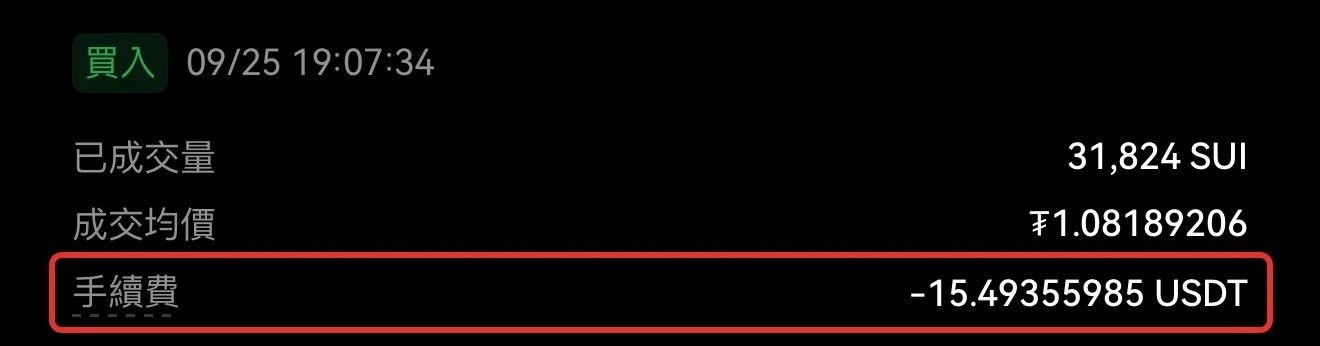 One taker fill on my VIP 1 account: 31,824 × 1.08189206 ≈ 34,430 USDT, × 0.045% ≈ 15.49 USDT, charged in full at the VIP 1 rate when the order filled. Screenshot from September 2026, app in Traditional Chinese.
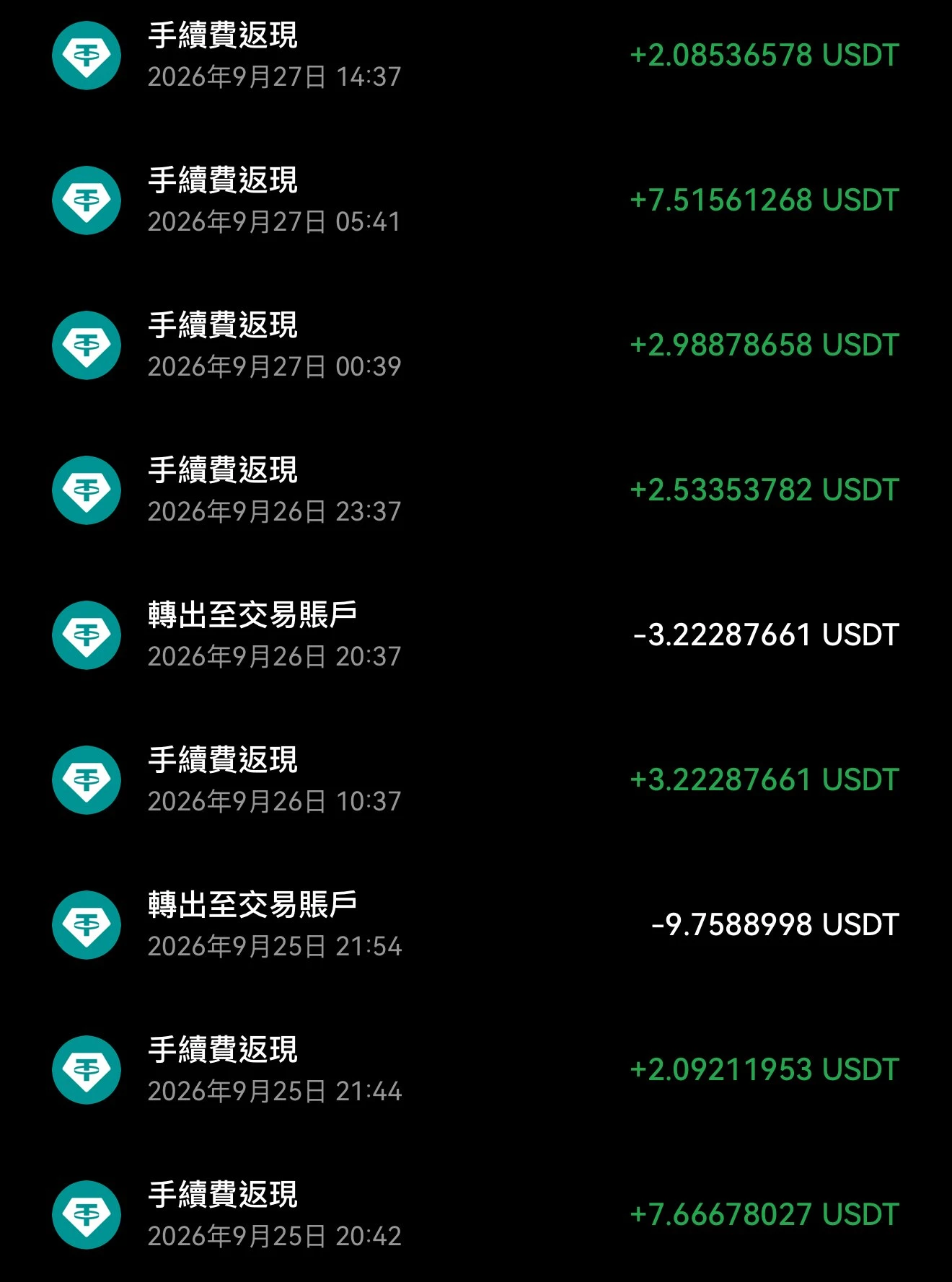 The funding bill for the same days: after that fill on 25 September, refunded fees arrived at 20:42 and 21:44 the same evening, then almost every day after. Screenshot from September 2026, app in Traditional Chinese.
What you pay trading 1,000, 10,000 or 100,000 USDT a month
The monthly fees below use OKX’s official rates. “Monthly trading volume” is buys and sells added together: buying 5,000 USDT and then selling it counts as 10,000 USDT. Futures are counted by the value of the position traded, not the margin. 100,000 USDT a month is not enough volume to reach VIP 1, so the two VIP 1 columns assume US$100,000 in assets.
Spot market orders (taker)
Formula: monthly volume × fee rate. For example, 10,000 × 0.1% × (1 − 20%) = 8 USDT.
| Monthly volume | Regular 0.1% | With 20% rebate 0.08% | VIP 1 0.08% | VIP 1 + rebate 0.064% |
|---|---|---|---|---|
| 1,000 USDT | 1 | 0.8 | 0.8 | 0.64 |
| 10,000 USDT | 10 | 8 | 8 | 6.4 |
| 100,000 USDT | 100 | 80 | 80 | 64 |
Amounts in USDT. At 10,000 USDT a month, a year comes to 120 USDT as a regular user, 96 USDT with the rebate, and 76.8 USDT with VIP 1 plus the rebate.
Futures market orders (taker)
Same formula, for example 10,000 × 0.05% × (1 − 20%) = 4 USDT.
| Monthly volume | Regular 0.05% | With 20% rebate 0.04% | VIP 1 0.045% | VIP 1 + rebate 0.036% |
|---|---|---|---|---|
| 1,000 USDT | 0.5 | 0.4 | 0.45 | 0.36 |
| 10,000 USDT | 5 | 4 | 4.5 | 3.6 |
| 100,000 USDT | 50 | 40 | 45 | 36 |
- If your limit orders fill as maker instead, regular users pay 0.08% on spot: 8 USDT on 10,000 USDT a month, or 6.4 USDT with the rebate.
- The tables cover fees only. Large market orders also have slippage, and futures also have funding fees; see “Costs that are easy to miss” below.
- To work it out with your own volume and maker/taker mix, use the calculator below.
Handy tool
Want to know what your monthly trading volume costs in fees at each exchange? Enter your amount and how you trade to compare official rates with your cost after the fee rebate.
Start calculatingCompared with Binance, Bybit and Bitget: regular-user fees
The table shows official regular-user fees for all four exchanges, checked on the same day (8 October 2026) and taken from this site’s exchange data table. Links to each exchange’s official fee page are in the international exchange fee comparison. I checked OKX’s rates again on 31 October and they had not changed.
| Exchange | Spot maker | Spot taker | Futures maker | Futures taker | Platform token discount |
|---|---|---|---|---|---|
| OKX | 0.08% | 0.1% | 0.02% | 0.05% | None |
| Binance | 0.1% | 0.1% | 0.02% | 0.05% | Paying in BNB: 25% off spot, 10% off futures |
| Bybit | 0.1% | 0.1% | 0.02% | 0.055% | Paying in MNT: 25% off spot, 10% off futures |
| Bitget | 0.1% | 0.1% | 0.02% | 0.06% | Paying in BGB: 20% off spot |
At official rates on 10,000 USDT a month:
- Spot market orders: 10 USDT at all four, no difference.
- Spot limit orders filled as maker: 8 USDT at OKX, 10 USDT at the other three.
- Futures market orders: 5 USDT at OKX and Binance, 5.5 USDT at Bybit, 6 USDT at Bitget.
- Platform tokens: the other three give a discount when you pay fees in their platform token; OKX does not. Platform token prices move, and the fees you save may not make up for it. The math is in “Are platform token fee rebates worth it?”.
VIP 1 thresholds differ too. According to the official data gathered in the international exchange fee comparison, Bybit, like OKX, lets you reach VIP 1 with US$100,000 in assets. Binance spot requires US$1 million of 30-day volume and 5 BNB held. Bitget requires 500,000 USDT of 30-day spot volume or 30,000 USDT in assets. The fee rebate you can get with each exchange’s invitation code differs as well; see “Crypto exchange fee rebates”. For head-to-head comparisons of features and security, see Binance vs OKX, Bybit vs OKX and OKX vs Bitget.
How to check your fee rate and that the fee rebate applies
OKX refunds the fee rebate after the trade, so if you only look at the trade details, it looks as if there was no rebate. Check your account in this order. The paths come from OKX’s trading fee FAQ and the EEA Affiliate FAQ; names may differ slightly after app updates.
- Check that an invitation code and rate are linked: in the app, the profile page (user center → account info) has an “Invite perks” row. 20 means a 20% fee rebate. If the row isn’t there, no invitation code is linked to the account.
- Check your tier and rates: on the website, go to “Assets → My trading fees”; in the app, go to “grid icon → Account settings → Profile → Trading fee tier”. This shows the standard rates for your VIP tier, without the fee rebate.
- Check the fee on a single trade: in the app, “Trade → Trade history → Order history”, then open the fill details to see the fee charged. On the website, use “Order history” on the trading page, click “Details” and hover over the fee to see how it was calculated. This amount is at the standard rate; check that it equals “trade amount × your rate”.
- Find the refunded rebate: go to “Assets → Order center → Funding history” (the funding account statement in the app) and look for fee refund credits after your trades. Each should be about 20% of the fee from step 3.
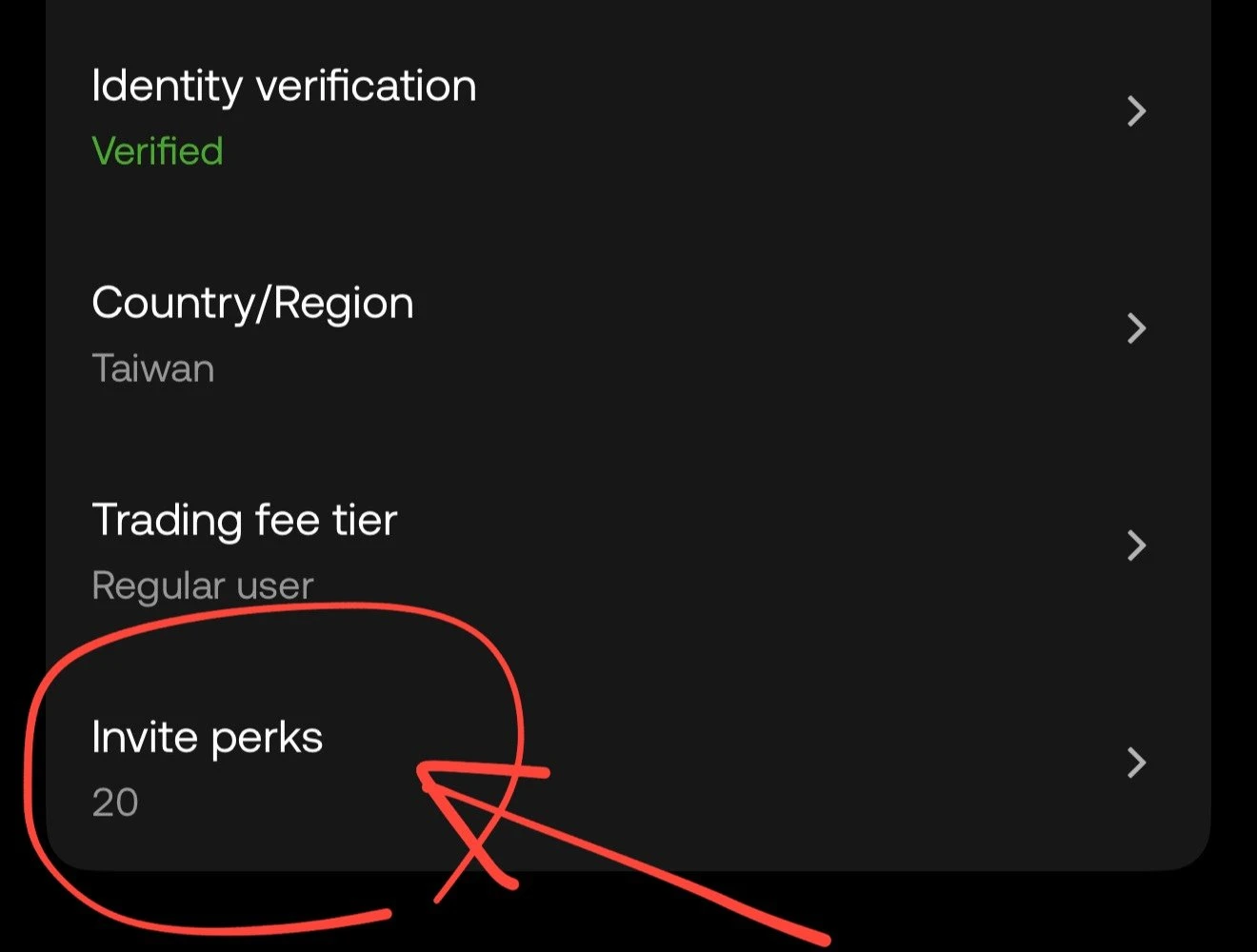 An OKX account registered with an invitation code: “Invite perks” on the profile page shows 20. Screenshot from October 2026
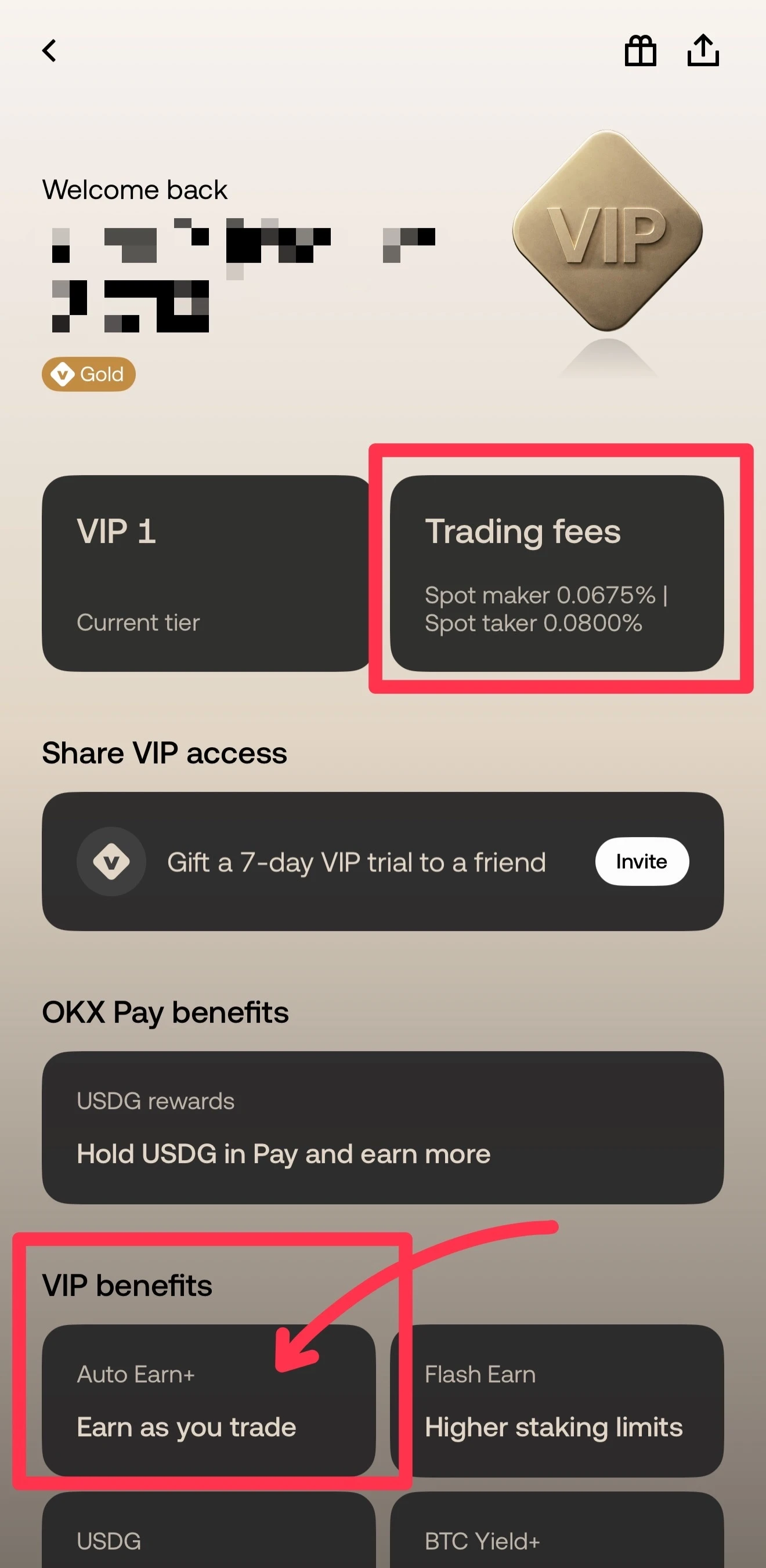 My OKX VIP 1 fee rates, matching VIP 1 on the official fee schedule. Screenshot from October 2026
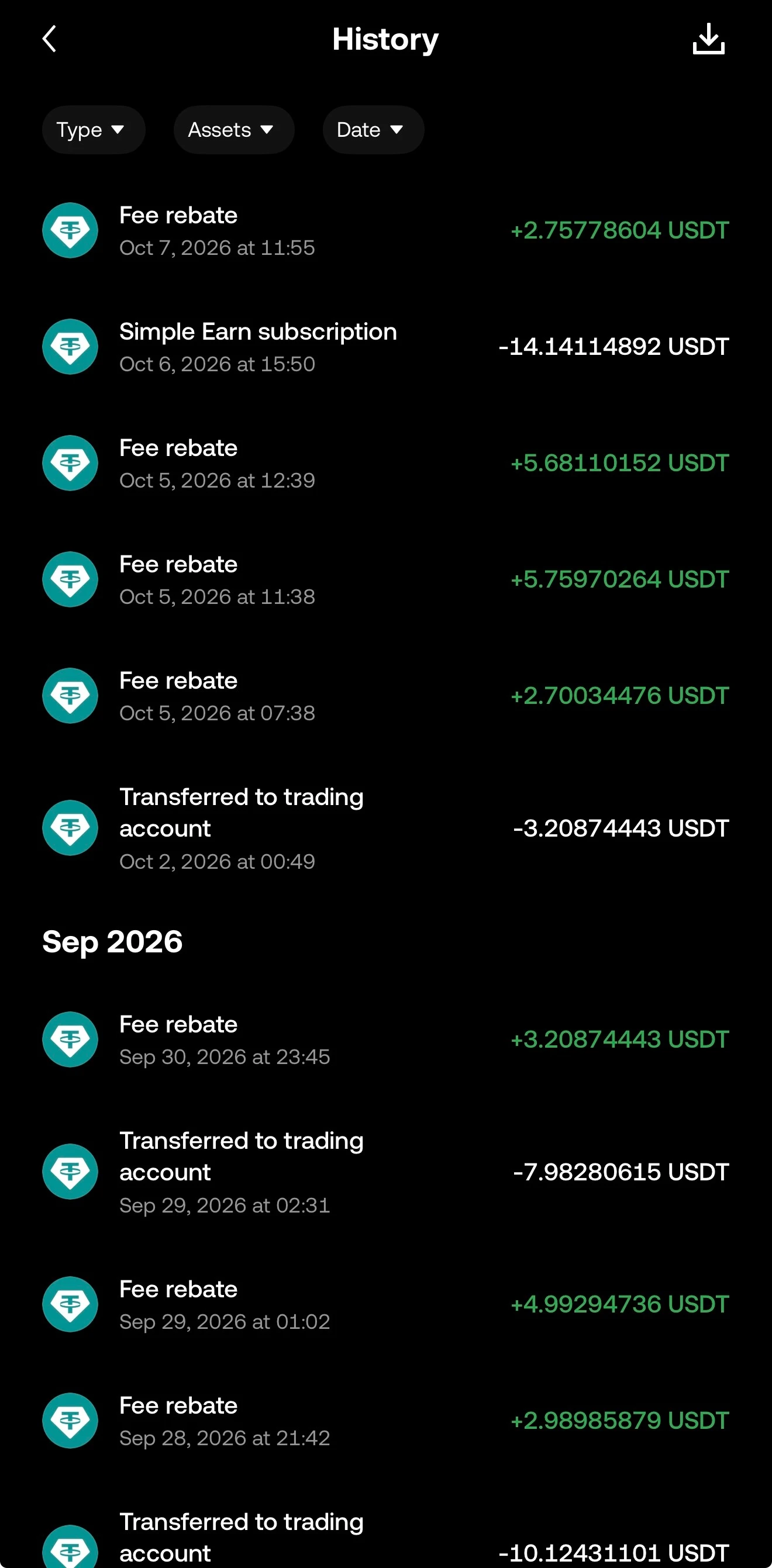 Daily fee rebates refunded to the funding account. Screenshot from October 2026
Take my VIP 1 account: a market buy of 1,000 USDT of BTC is charged 0.08% at the time of the trade, or 0.8 USDT worth. The 20% rebate, 0.16 USDT, is refunded to the funding account the same day, so the net cost is 0.64 USDT.
The invitation code has to be entered at sign-up: according to the EEA Affiliate FAQ, it cannot be added after the account is created. Also, the trading fee FAQ says trading fees on filled orders are not refunded.
Costs that are easy to miss: the Convert spread, withdrawal fees, funding fees and the earn commission
Convert and Buy/Sell: zero fees, but the quote includes a spread
OKX Convert and Buy/Sell charge no maker or taker fee. Instead, you get a quote that includes a spread. OKX’s “What costs apply besides trading fees?” (4 September 2026) says that “zero trading fees does not mean zero cost”, and the spread disclosure page (updated 11 August 2026) lists a spread cap of 1.00% for all pairs. It also says the spread may differ by market and region.
At the cap, converting 1,000 USDT costs up to about 10 USDT in spread. The same amount as a spot market order costs 1 USDT in fees, or 0.8 USDT with the rebate. 1% is a cap; the actual spread depends on the market and the pair. And according to the EEA FAQ above, Convert does not get the fee rebate either.
OKX’s “Why did I pay more than the market price?” (4 September 2026) says that if you don’t want to pay the spread, you can use a spot limit order instead, at the cost that it may not fill. How spread and slippage affect your fill price is covered in “Are zero-fee exchanges really cheaper? The three parts of trading costs”.
USDT deposit and withdrawal fees
According to OKX’s “Do I need to pay fees for deposit and withdrawal?” (updated 5 August 2026), deposits are free. Each withdrawal pays a network fee per transaction, regardless of the amount. The fee is adjusted to network conditions; go by the withdrawal page. Deposits below the minimum deposit amount are not credited, and only some coins can be recovered, for an extra fee.
USDT withdrawal fees and minimum withdrawals on common networks:
| Network | Withdrawal fee | Minimum withdrawal |
|---|---|---|
| TRC20 | 1.5 USDT | 10 USDT |
| ERC20 | 0.24 USDT | 2 USDT |
| Solana | 0.27 USDT | 2 USDT |
| TON | 0.016 USDT | 2 USDT |
| Arbitrum | 0.0031 USDT | 2 USDT |
| Polygon | 0.27 USDT | 2 USDT |
Official public data as of 2026-11-01, updated monthly; the withdrawal page shows the fee that applies. Source · Past changes are in the data update log
- On small withdrawals, the withdrawal fee can cost more than the trading fee: withdrawing 100 USDT on TRC20, the 1.5 USDT fee is 1.5%, 15 times the spot taker fee on 100 USDT (0.1 USDT). In OKX’s official data on 31 October 2026, Arbitrum One was 0.003 USDT, Polygon 0.011 USDT and TON 0.017 USDT.
- OKX does not support BEP20: on 31 October 2026 the USDT withdrawal network list did not include BNB Smart Chain. If the receiving side only supports BEP20, you need a different network.
- Before you pick a network, make sure the receiving side supports the same one. How to choose: “How to choose a USDT withdrawal network”.
Futures funding fees, delivery fees and liquidation fees
The trading fee FAQ also lists several futures costs. They are here only so readers know the costs, not as trading advice:
- Funding fees are not trading fees: perpetual futures funding is settled between longs and shorts, the platform takes no cut, and it is settled every 8, 4, 2 or 1 hours depending on the coin.
- Delivery fee: when expiry futures are delivered, all users pay 0.01%, regardless of tier.
- Liquidation fee: charged at the taker rate for your current tier.
OKX keeps 15% of earn interest
If you put idle coins into Simple Earn Flexible, the official FAQ (updated 29 October 2026) gives the earnings formula as “amount lent × APR ÷ 365 ÷ 24 × 85%”, meaning OKX keeps 15% of the market interest. The new-user bonus APR portion is not subject to this 15%. Using the official example of 1,000 USDT at a 5% market APR, a year of market interest is about 50 USDT, or about 42.5 USDT after the 15% (without compounding). For earn conditions across exchanges, see “Exchange Auto Earn compared”.
The OKX fee rebate when you sign up with an invitation code
OKX is an international exchange. The rate, invitation code and sign-up screenshot in the box below come from the same data, synced daily. Signing up with the invitation code gives a 20% fee rebate, the same for spot and futures, refunded to the funding account after you trade.
Why some sites advertise 30% or 50% OKX invitation codes, and how to check the rate yourself before signing up: OKX invitation code.
OKX’s proof of reserves, its 2020 withdrawal suspension, its 2025 US guilty plea and its licences are covered in the OKX review, which is worth reading before you sign up. More exchange fee guides and reviews are on the crypto topic page.
FAQ
What are OKX's trading fees?
According to OKX's official fee schedule for the global site (checked 31 October 2026), regular users pay 0.08% maker and 0.1% taker on standard spot pairs, and 0.02% maker and 0.05% taker on futures. A 1,000 USDT spot market order costs 1 USDT in fees.
What do I need for OKX VIP 1?
Any one of these: US$100,000 in assets, US$1 million of 30-day spot volume, or US$5 million of 30-day futures volume. Each is checked separately and you get the highest tier you qualify for, which applies to all trading types. Tiers are updated every day between 4:00 and 6:00 (UTC+8).
Does the OKX invitation code fee rebate work together with VIP?
Yes. My account is VIP 1: trades are charged the VIP 1 rate, and the 20% rebate comes back to the funding account on the day of the trade. With a 20% fee rebate, a regular user's spot taker fee works out to 0.08%, the same as the VIP 1 taker rate.
Can holding OKB reduce OKX trading fees?
No. OKX's trading fee FAQ (updated 9 September 2026) says the platform currently does not offer a way to use OKB to offset trading fees, and holding OKB does not affect your fee tier.
Does OKX Convert charge a fee?
Convert and Buy/Sell charge no separate fee, but the quote includes a spread. OKX publishes a spread cap of 1.00% for all pairs, so converting 1,000 USDT can cost up to about 10 USDT, more than the 1 USDT fee on a spot market order.
How much does OKX charge to withdraw USDT?
Deposits are free. Each withdrawal pays one network fee regardless of the amount. In OKX's official data on 31 October 2026, TRC20 was 1.5 USDT and networks such as Arbitrum, Polygon and TON were under 0.02 USDT. OKX does not support USDT withdrawals on BEP20.
How much do I pay in fees if I trade 10,000 USDT a month on OKX?
If every trade is a spot market order, a regular user pays 10 USDT, 8 USDT with the 20% fee rebate, and 6.4 USDT with VIP 1 (by assets) plus the rebate. For futures market orders the figures are 5, 4 and 3.6 USDT.

Comments
Sign in with Google to comment. Your comment will not show your Google profile picture or name; it appears under a randomly generated nickname to protect your privacy.
By signing in you agree to this site's privacy policy.