 Jason Finance
Bybit Fees 2026: 0.1% Spot, 0.02%/0.055% Futures, 50% Off Taker Fees on USDC Pairs, MNT Discount, VIP Thresholds and Monthly Cost Examples

Disclosure: this page contains exchange invitation links and codes. If you sign up through them, the exchange may pay Jason Finance a referral commission. It does not raise the fees you pay; the invitation fee rebate is set by the exchange. Our ratings follow the published methodology, where the invitation rebate counts only toward the fees item.
On this page
- 1.Bybit fees at a glance: 0.1% spot and 0.02%/0.055% futures for regular users
- 2.50% off taker fees on USDC pairs: the most effective way for regular Bybit users to save
- 3.Paying fees in MNT: 25% off spot, 10% off futures
- 4.Bybit VIP tiers: thresholds and fee table
- 4.1What VIP 1 saves at ordinary trading volumes
- 5.Does the Bybit invitation code give a fee rebate?
- 6.What you pay trading 1,000, 10,000 or 100,000 USDT a month
- 6.1Spot market orders (taker)
- 6.2Futures market orders (taker)
- 7.Compared with OKX, Binance and Bitget: regular-user fees
- 8.How to check your fee rate
- 9.Costs that are easy to miss: the Convert spread, withdrawal fees, funding fees and regional differences
- 9.1Convert: zero fees, but the rate may differ from spot
- 9.2USDT deposit and withdrawal fees
- 9.3Futures funding fees, settlement fees and liquidation
- 9.4Bybit’s fees differ by region
- 10.Signing up for Bybit
- FAQ
The short answer
Regular Bybit users pay 0.1% maker and taker on spot and 0.02%/0.055% on futures; the futures taker fee is slightly above the 0.05% at OKX and Binance. The best saving is not switching exchanges but using USDC pairs: manual traders get 50% off taker fees, 0.05% on spot and 0.0275% on futures. MNT gives 25% off spot if you hold MNT. This site's Bybit code has no fee rebate.
Suits
- People who buy and sell major coins with USDC pairs, such as BTC and ETH, using market orders they place by hand
- People with close to US$100,000 in assets who can use VIP 1 to lower their rates
- People who move USDT on low-fee networks such as BEP20, Polygon and Arbitrum
Doesn't suit
- Residents of the European Economic Area: on Bybit EU, regular users pay 0.25% on spot, more than on the global site
- Residents of Hong Kong, Singapore, mainland China, the US and the UK: Bybit does not serve them or has stopped new sign-ups
- People who want a fee rebate from an invitation code: this site's Bybit invitation code has no fee cashback
What would change this verdict
- Bybit ends or changes the 50% taker fee discount on USDC pairs
- Bybit changes regular-user fees, VIP thresholds or the MNT discount
Bybit fees come down to four things: regular-user maker and taker rates, 50% off taker fees on USDC pairs, the discount for paying fees in MNT, and VIP thresholds. This article is based on Bybit’s official help center, fee page and trading pages as of 2 November 2026, and works out what you actually pay if you trade 1,000 to 100,000 USDT a month.
Two results stand out. First, since 23 March 2026, Bybit has given regular users who trade manually 50% off taker fees on USDC pairs: spot goes from 0.1% to 0.05%, and futures from 0.055% to 0.0275%. Buying the same BTC with BTC/USDC costs half the fee of BTC/USDT, and converting between USDC and USDT has no fee. Second, Bybit’s help center publishes no fee rebate rules for invitees: only a few affiliate codes show a cashback rate on Bybit’s sign-up page (with no published terms), and this site’s code does not, unlike OKX, Binance and Bitget. On Bybit, the most reliable savings come from the trading pair you choose, MNT, limit orders that rest on the book, and VIP tiers.
This article is a summary of information, not investment advice. The fees here are figures taken from Bybit’s official help center, fee page, trading pages and public data on 2 November 2026. They change, so check Bybit’s current pages before you trade. Bybit says fees may differ by region, and after you complete identity verification, your “My Fee Rate” page is what counts; this article covers the global site. This site does not give advice on futures or leveraged trading; futures fees are listed only so readers can compare costs.
Bybit key factsData checked: 2026-10-08
As of 2026-10-08, Bybit's general-user spot taker fee is 0.1% and its futures taker fee is 0.055%. Its 2026-09-23 proof of reserves showed BTC 104%, ETH 103%, USDT 110%.
| Item | Details | Source |
|---|---|---|
| Jason Finance rating | 58.2 / 100 | rating method |
| Highlights | Hacken-verified monthly proof of reserves 2025 hack: users made whole, withdrawals stayed open EU MiCA authorisation | |
| General-user fees (taker) | Spot 0.1%, futures 0.055% | 2026-10-08 |
| Invitation code fee rebate | Official sign-up offer (not a fee rebate) | 2026-10-31 |
| Proof of reserves | 2026-09-23 (monthly): BTC 104%, ETH 103%, USDT 110% | 2026-10-08 |
| Main licences and registrations | EU MiCA (Austria FMA), UAE SCA licence, India FIU registration | source 1 source 2 source 3 |
| Order book depth (±2%) | BTC/USDT about 8.2M USD, ETH/USDT about 4.1M USD | 2026-10-08 |
Bybit fees at a glance: 0.1% spot and 0.02%/0.055% futures for regular users
Regular-user (VIP 0) rates on Bybit’s “Bybit Trading Fee Structure” (updated 2 September 2026):
| Trading type | Maker | Taker |
|---|---|---|
| Spot (crypto pairs) | 0.1% | 0.1% |
| USDT perpetual, USDT expiry and USDC perpetual contracts | 0.02% | 0.055% |
| Options | 0.02% | 0.03% |
| Fiat pairs (30-day volume under US$100,000) | 0.15% | 0.2% |
| Spot Adventure Zone and stock tokens (xStocks) | 0.2% | 0.2% |
- Maker or taker depends on how the order fills: a market order is a taker order, and a limit order that fills immediately against an order on the book is also a taker order. To make sure you pay the maker rate, see “A limit order is not always a maker order: how Post-only makes sure you pay the maker fee”. On Bybit spot, maker and taker are both 0.1%, so limit orders that rest on the book save nothing on Bybit spot, unlike OKX (0.08% maker).
- Spot fees are taken from the coin you buy: “Spot Trading: Fees Explained” says “The trading fee unit charged is based on the purchased cryptocurrency”, and cancelled orders and unfilled parts are not charged. For example, on a market buy of BTC, the fee comes out of the BTC you receive.
- Futures charge once to open and once to close: the fee is based on the value of the position traded, not the leverage.
- 10 pairs have zero fees: in Bybit’s spot pair data on 2 November 2026, the pairs labeled “0 Fees” included stablecoin pairs such as USDC/USDT, PYUSD/USDT, RLUSD/USDT, USD1/USDT, USDE/USDT and USDTB/USDT, plus WBTC/BTC. Bybit says zero-fee trades do not count toward 30-day spot volume.
50% off taker fees on USDC pairs: the most effective way for regular Bybit users to save
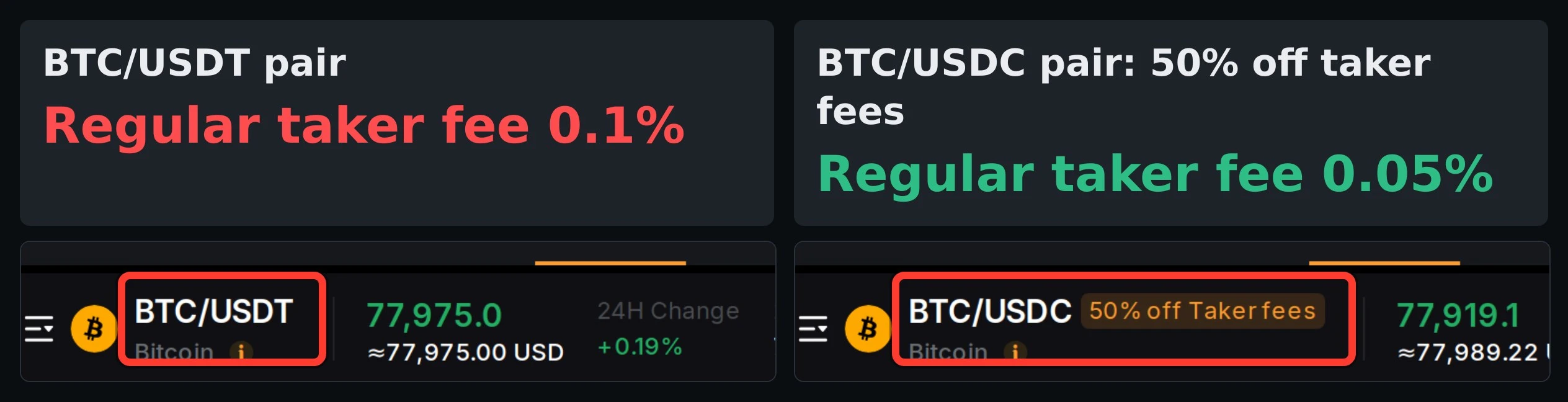
The comparison image at the top of this article is Bybit’s official trading page: BTC/USDC is labeled “50% off Taker fees” and BTC/USDT is not. According to Bybit’s announcement of 19 March 2026, “Fee discounts for retail clients on USDC trading pairs”, from 23 March:
| Tier | Spot taker: standard → USDC pairs | Futures taker: standard → USDC contracts |
|---|---|---|
| Regular user (VIP 0) | 0.1% → 0.05% | 0.055% → 0.0275% |
| VIP 1 | 0.08% → 0.04% | 0.04% → 0.02% |
| VIP 2 | 0.0775% → 0.0388% | 0.0375% → 0.0188% |
| VIP 5 | 0.05% → 0.025% | 0.032% → 0.016% |
Conditions:
- It applies only to USDC-denominated spot and futures pairs, and maker fees stay the same;
- It is only for users who trade manually: API trading must be less than 20% of your USDC trading volume;
- It does not apply to Pro accounts, or to futures users in the CIS region, Georgia, Moldova and Ukraine;
- The announcement says Bybit may decide eligibility and timing at its sole discretion, and it uses the phrase “event period”, but it gives no end date. On 2 November 2026, Bybit’s spot pair data still had 80 USDC pairs labeled “50% Fees”.
How to use it: if you hold USDT, first convert it to USDC on the USDC/USDT pair (this pair has zero fees), then place your orders on BTC/USDC or ETH/USDC. Reverse the steps when you sell. Two things to watch:
- USDC/USDT is not always exactly 1: the conversion has a very small price difference, which you should include in your math if you trade large amounts.
- Check the label next to the pair before you place an order: you only get the discount if the trading page shows “50% off Taker fees”. If the label is gone, the promotion has ended or does not apply to that pair.
On 10,000 USDT a month of spot market orders, BTC/USDT costs 10 USDT and BTC/USDC costs 5 USDT, a difference of 60 USDT a year. That saves twice as much as the MNT discount (25% off), and you don’t have to hold a platform token whose price moves. For the differences between USDC and USDT, see “USDT vs USDC”.
Paying fees in MNT: 25% off spot, 10% off futures
Bybit’s “FAQ: Paying Trading Fees with MNT” (updated 30 March 2026) says paying fees in MNT gives 25% off spot and 10% off futures. For regular users, that works out to:
| Trading type | Standard maker/taker | Paying in MNT |
|---|---|---|
| Spot | 0.1%/0.1% | 0.075%/0.075% |
| Futures | 0.02%/0.055% | 0.018%/0.0495% |
- You have to turn it on yourself: turn on “Using MNT for fee discount” in the fee settings, separately for spot and futures. Only MNT in your Unified Trading Account is used.
- When it does not apply: API orders, trading bots, liquidations, inverse contracts, Pro accounts and some other cases.
- Without enough MNT, you pay the full fee: if your balance is too low, the full fee is charged in the settlement currency.
- MNT’s price moves: if you hold MNT to save on fees, the fees you save may not make up for a drop in MNT’s price. The math is in “Are platform token fee rebates worth it?”.
Bybit’s documentation does not say whether the USDC 50% discount and the MNT discount stack; go by the fee actually charged on your trades.
Bybit VIP tiers: thresholds and fee table
According to the “Bybit Trading Fee Structure” and “Introduction to the VIP Program”, you move up when you meet the asset threshold or any one of the 30-day volume thresholds (amounts in US dollars):
| Tier | Assets | 30-day spot volume | 30-day derivatives volume | Spot maker/taker | Futures maker/taker |
|---|---|---|---|---|---|
| VIP 0 | Under 100,000 | Under 1 million | Under 10 million | 0.1%/0.1% | 0.02%/0.055% |
| VIP 1 | 100,000 | 1 million | 10 million | 0.0675%/0.08% | 0.018%/0.04% |
| VIP 2 | 250,000 | 5 million | 25 million | 0.065%/0.0775% | 0.016%/0.0375% |
| VIP 3 | 500,000 | 10 million | 50 million | 0.0625%/0.075% | 0.014%/0.035% |
| VIP 4 | 1 million | 25 million | 100 million | 0.05%/0.06% | 0.012%/0.032% |
| VIP 5 | 2 million | 50 million | 250 million | 0.04%/0.05% | 0.01%/0.032% |
| Supreme VIP | N/A | 100 million | 500 million | 0.03%/0.045% | 0%/0.03% |
- Tiers update once a day: your tier and progress are updated at 7:00 UTC (15:00 Taipei time) the next day and take effect within minutes; an order uses your tier at the time you place it.
- 14-day protection period: “FAQ: Bybit VIP Program” says that if you no longer meet the requirements, your VIP status is protected for 14 days.
- Main accounts and subaccounts are combined, and subaccounts use the main account’s rates. Funding fees do not count toward volume.
- MNT gets extra weight in your assets: “Introduction to the MNT Program” says MNT you hold is multiplied by 1.5 for regular users and by 1.4 for VIP 1 to 3 when your assets are checked against VIP thresholds. For example, about US$67,000 of MNT counts as US$100,000 in assets.
- Volume thresholds from VIP 4 up require API trading to be 20% or less of your volume. Users with a higher API share go to Pro tiers, but Bybit says Pro status does not apply to affiliate and referral users.
- Supreme VIP is by invitation only.
What VIP 1 saves at ordinary trading volumes
For most people, the likeliest route is US$100,000 in assets, or about US$67,000 of MNT. VIP 1 lowers the spot taker fee from 0.1% to 0.08%, which saves 2 USDT a month on 10,000 USDT of trading, or 24 USDT a year.
On the same 10,000 USDT a month, though, switching to USDC pairs saves 60 USDT a year, without keeping US$100,000 on the exchange. At ordinary trading volumes, USDC pairs are far more effective than chasing VIP 1.
Does the Bybit invitation code give a fee rebate?
Not in the help center, but some affiliate codes show one on the sign-up page. I checked Bybit’s “FAQ: Referral Program” (10 October 2026), “FAQ: Affiliate Program” (29 October 2026) and the Affiliate Program terms, and none of them provide a fee rebate or refund for invitees:
- Referral Program (users inviting users): invitees get task rewards. Invitees who registered on or after 10 October 2026 get 50 USDT for a first trade of at least US$50 within 14 days, and can then complete volume-based tasks. Rewards go through a 3-day risk review and must be claimed within 10 days.
- Affiliate Program: the Bybit Affiliate Program terms have no mechanism that gives invitees a fee rebate. Invitees get each region’s new-user promotion rewards.
But when you open Bybit’s official sign-up page, a few affiliate codes show this line under the code field: “You will be eligible to 20% fee cashback. Terms & condition apply.” On 4 November 2026 I checked 32 Bybit invitation codes found online: only 3 showed this line (20%, 20% and 33%), and the rest showed nothing. The line belongs to the code, not the account: of two codes introduced by the same promoter on the same page, one showed 20% and the other showed nothing. The line links to no terms, and the help center does not explain how it is paid, so whether it is actually paid cannot be confirmed. This site’s Bybit invitation code does not show this line, so it has no fee cashback. Most pages advertising 30% or 50% for a Bybit code show no fee text at all on Bybit’s sign-up page. The full check results, and how to check a code yourself before signing up, are in “Bybit referral code”.
So on Bybit, the most reliable savings come from the methods in the sections above: USDC pairs, the MNT discount, limit orders that rest on the book, and VIP tiers. The fee rebate rates for each exchange’s invitation code are listed in “Crypto exchange fee rebates”.
What you pay trading 1,000, 10,000 or 100,000 USDT a month
“Monthly trading volume” is buys and sells added together; futures are counted by the value of the position traded, not the margin. 100,000 USDT a month is not enough volume to reach VIP 1, so the two VIP 1 columns assume US$100,000 in assets.
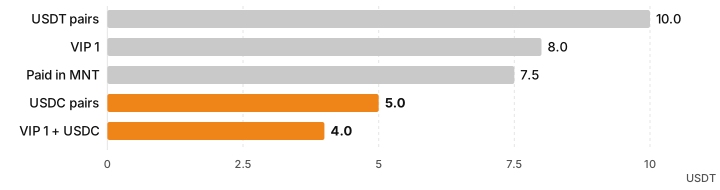
Spot market orders (taker)
| Monthly volume | USDT pair 0.1% | Paying in MNT 0.075% | VIP 1 0.08% | USDC pair 0.05% | VIP 1 + USDC 0.04% |
|---|---|---|---|---|---|
| 1,000 USDT | 1 | 0.75 | 0.8 | 0.5 | 0.4 |
| 10,000 USDT | 10 | 7.5 | 8 | 5 | 4 |
| 100,000 USDT | 100 | 75 | 80 | 50 | 40 |
Futures market orders (taker)
| Monthly volume | USDT contracts 0.055% | Paying in MNT 0.0495% | VIP 1 0.04% | USDC contracts 0.0275% |
|---|---|---|---|---|
| 1,000 USDT | 0.55 | 0.495 | 0.4 | 0.275 |
| 10,000 USDT | 5.5 | 4.95 | 4 | 2.75 |
| 100,000 USDT | 55 | 49.5 | 40 | 27.5 |
Amounts in USDT. The tables cover fees only; USDC pairs require a conversion first, and the USDC/USDT price difference is extra. Large market orders also have slippage, and futures also have funding fees; see “Costs that are easy to miss” below.
Handy tool
Want to know what your monthly trading volume costs in fees at each exchange? Enter your amount and how you trade to compare official rates with your cost after the fee rebate.
Start calculatingCompared with OKX, Binance and Bitget: regular-user fees
The OKX, Binance and Bitget figures below are official rates from this site’s exchange data table on 8 October 2026. I checked Bybit again on 2 November, and its rates were the same as on 8 October. Links to each exchange’s official fee page are in the international exchange fee comparison.
| Exchange | Spot maker | Spot taker | Futures maker | Futures taker | Platform token discount | Invitation code fee rebate |
|---|---|---|---|---|---|---|
| Bybit | 0.1% | 0.1% | 0.02% | 0.055% | MNT: 25% off spot, 10% off futures | None for this site’s code; a few affiliate codes show 20% to 33% cashback on the sign-up page |
| OKX | 0.08% | 0.1% | 0.02% | 0.05% | None | Up to 20% |
| Binance | 0.1% | 0.1% | 0.02% | 0.05% | BNB: 25% off spot, 10% off futures | Up to 20% |
| Bitget | 0.1% | 0.1% | 0.02% | 0.06% | BGB: 20% off spot | Up to 20% |
- Spot market orders: regular users pay 0.1% at all four. On Bybit, USDC pairs cost 0.05%, lower than the 0.08% you pay at the other three after a 20% fee rebate from an invitation code.
- Spot limit orders filled as maker: OKX is lowest at 0.08%; on Bybit, maker orders cost no less than taker orders.
- Futures taker: Bybit’s 0.055% is slightly higher than the 0.05% at OKX and Binance, but USDC contracts cost 0.0275%.
- For head-to-head comparisons of features and security, see Bybit vs OKX and Bitget vs Bybit.
How to check your fee rate
Bybit says fees may differ by region, and after you complete identity verification, your own fee rate page is what counts:
- My Fee Rate: on the website, hover over the profile icon at the top right and choose “My Fee Rate” (bybit.com/en/my-fee-rate); in the app, it is “My Fee Rate” in your profile settings. It shows your VIP tier and the standard rates for each product.
- The USDC 50% discount: before you place an order, check whether the pair name has the “50% off Taker fees” label next to it.
- The fee on a single trade: “Trade History” at the bottom of the trading page lists the fee for each fill; if you paid in MNT, the trade history and transaction log show the fee deducted in MNT. Check that it equals “trade amount × your fee rate”.
Costs that are easy to miss: the Convert spread, withdrawal fees, funding fees and regional differences
Convert: zero fees, but the rate may differ from spot
Bybit’s “How to Convert Your Assets” says Convert comes “with zero traditional trading fees”, but the rate is based on market maker quotes and may differ from the Bybit spot market price. Bybit does not publish a cap on the spread; to see how big it is, compare the quote with the live price on the spot trading page. How spread and slippage affect your fill price is covered in “Are zero-fee exchanges really cheaper? The three parts of trading costs”.
USDT deposit and withdrawal fees
Deposits and internal transfers between Bybit accounts are free. Each withdrawal pays a fixed network fee, regardless of the amount. Data from Bybit’s official withdrawal status page on 2 November 2026:
| Network | Withdrawal fee (USDT) | Minimum withdrawal (USDT) |
|---|---|---|
| TRC20 | 1.3 | 2.6 |
| ERC20 | 0.8 | 6 |
| BEP20 | 0.15 | 10 |
| Solana | 0.5 | 10 |
| TON | 0.15 | 1 |
| Polygon | 0.07 | 1 |
| Arbitrum (USDT0) | 0.1 | 1 |
- On small withdrawals, the withdrawal fee can cost more than the trading fee: withdrawing 100 USDT on TRC20, the 1.3 USDT fee is 1.3%, 13 times the spot fee on 100 USDT (0.1 USDT). On Polygon it is only 0.07 USDT.
- Fees change, so go by what the withdrawal page shows. Before you pick a network, make sure the receiving side supports the same one; see “How to choose a USDT withdrawal network”.
Futures funding fees, settlement fees and liquidation
These are here only so readers know the costs, not as trading advice:
- Funding fees are not trading fees: they are settled between longs and shorts, every 8 or 4 hours depending on the contract. In the data on 2 November 2026, BTC/USDT and ETH/USDT perpetuals settled every 8 hours. When the funding rate hits its cap, the system automatically switches to hourly settlement.
- USDT expiry contracts have no settlement fee; inverse expiry contracts charge 0.05%.
- Perpetual and expiry contracts have no liquidation fee: “Bybit’s Fees That You Need to Know” says there is no such fee; according to Bybit’s “Insurance Fund” page, the position is closed at the bankruptcy price and the remaining margin goes to the insurance fund. Liquidations in spot margin trading and crypto loans are charged 2%, and options 0.2%.
Bybit’s fees differ by region
- European Economic Area (Bybit EU): from 5 October 2026 it moved to a single fee rate, and regular users pay 0.25% on spot, more than the 0.1% on the global site.
- Turkey (Bybit TR): crypto pairs cost the same as on the global site; Turkish lira pairs have their own rates.
- India: an 18% goods and services tax is added to trading, withdrawals and spreads.
- Regions Bybit does not serve: Bybit’s terms of service (effective 16 October 2026) list the US, Canada, mainland China, Hong Kong, Singapore, Australia, France and others; the UK has not accepted new users since September 2026, and since 21 October users there can only withdraw.
Signing up for Bybit
Bybit is an international exchange. The invitation code and link in the box below come from data synced daily. This site’s Bybit invitation code has no fee rebate; it comes with Bybit’s official sign-up offers.
This site’s invitation codes are not for residents of the UK or Hong Kong. Please follow the laws where you live. Bybit’s proof of reserves, how it handled the theft of about US$1.5 billion in February 2025, and its licences are covered in the Bybit review, which is worth reading before you sign up. More exchange fee guides and reviews are on the crypto topic page.
FAQ
What are Bybit's trading fees?
According to Bybit's "Bybit Trading Fee Structure", regular users (VIP 0) pay 0.1% maker and 0.1% taker on spot, 0.02% maker and 0.055% taker on USDT perpetual and expiry contracts, and 0.02%/0.03% on options. A 1,000 USDT spot market buy costs 1 USDT in fees.
How can I lower my Bybit fees?
For regular users, the most direct way is to use USDC pairs: since 23 March 2026, Bybit gives users who trade manually 50% off taker fees on USDC spot and futures pairs, so spot goes from 0.1% to 0.05%. Next is paying fees in MNT, 25% off spot and 10% off futures. After that come limit orders that rest on the book, or moving up to VIP 1 with US$100,000 in assets.
Does a Bybit invitation code give a fee rebate?
Bybit's help-center pages on the Referral and Affiliate Programs describe no fee rebate for invitees. A few affiliate codes show "You will be eligible to X% fee cashback" on Bybit's sign-up page (of 32 codes found online and checked on 4 November 2026, 3 did: 20%, 20% and 33%). The line belongs to the code, not the account; it has no published terms, and whether it is paid cannot be confirmed. This site's Bybit invitation code has no such cashback. The most reliable ways to lower fees are USDC pairs, the MNT discount, limit orders that rest on the book and VIP tiers.
What do I need for Bybit VIP 1?
Any one of these: US$100,000 in assets, US$1 million of 30-day spot volume, or US$10 million of 30-day derivatives volume. Tiers are updated every day at 7:00 UTC, and MNT you hold is multiplied by 1.5 when your assets are calculated.
How much of a discount do I get paying Bybit fees in MNT?
According to Bybit's "FAQ: Paying Trading Fees with MNT", 25% off spot and 10% off futures. You have to turn it on in the settings, and only MNT in your Unified Trading Account is used. It does not apply to API orders, trading bots, liquidations or inverse contracts; if you don't have enough MNT, you pay the full fee.
Does Bybit charge a liquidation fee on futures?
Not on perpetual and expiry contracts. Bybit's "Bybit's Fees That You Need to Know" says it does not charge a liquidation fee on these contracts; according to its "Insurance Fund" page, the position is closed at the bankruptcy price and the remaining margin goes to the insurance fund. Liquidations in spot margin trading and crypto loans are charged 2%, and options 0.2%.
How much does Bybit charge to withdraw USDT?
Each withdrawal pays a fixed network fee regardless of the amount; deposits and internal transfers are free. In Bybit's official data on 2 November 2026: TRC20 1.3 USDT, ERC20 0.8 USDT, BEP20 0.15 USDT, Polygon 0.07 USDT, Arbitrum 0.1 USDT and TON 0.15 USDT. Go by what the withdrawal page shows.

Comments
Sign in with Google to comment. Your comment will not show your Google profile picture or name; it appears under a randomly generated nickname to protect your privacy.
By signing in you agree to this site's privacy policy.