 Jason Finance
Bitget Fees 2026: VIP 1 Keeps the 0.06% Futures Taker Fee, BGB Deduction Is Spot Only and Opt-in, 0.1% Spot, 0.02%/0.06% Futures and USDT Withdrawal Fees

On this page
- 1.Futures: VIP 1 only lowers the maker fee; the taker fee falls from 0.06% to 0.04% at VIP 2
- 2.Spot: VIP 1 drops to 0.08%, and so does BGB deduction
- 2.1You have to switch on BGB deduction, and without enough BGB you pay the full rate
- 3.Three routes to VIP: volume, assets or holding BGB
- 3.1Assets on a single day count: put in 30,000 USDT and you may move up the next day
- 3.2The BGB threshold: the asset threshold minus 20%, recalculated every two weeks
- 3.3Is VIP 1 worth it? The numbers for 10,000 USDT of trading a month
- 4.Only 6 stablecoin pairs have zero fees, and USDC pairs get no discount
- 5.Two more futures costs: funding and the liquidation fee
- 6.What your own account actually pays: check the fee schedule and your trade history
- 7.USDT withdrawals: 2 USDT per ERC20 withdrawal, more than Binance, OKX or Bybit
- 8.Convert, card purchases and P2P: zero fees, or check the checkout page
- FAQ
The short answer
Bitget charges regular users 0.1% on spot and 0.02%/0.06% on futures, close to OKX, Bybit and Binance. But futures VIP 1 keeps the taker fee, so VIP 1 saves nothing on futures market orders; spot VIP 1 drops to 0.08%. BGB takes 20% off spot fees once switched on, not futures. USDC pairs get no discount, and an ERC20 withdrawal costs 2 USDT, more than at the other three.
Suits
- People who mainly trade spot and are willing to hold a little BGB and switch on the deduction
- People who already keep about 30,000 USDT on Bitget and qualify for VIP 1: the spot taker fee drops to 0.08%
- People who move USDT over low-fee networks such as BEP20 or Arbitrum
Doesn't suit
- People hoping VIP 1 will lower the fee on futures market orders: VIP 1's futures taker fee is still 0.06%
- People hoping to save on fees with USDC pairs: Bitget has no USDC discount
- People who often withdraw over ERC20: 2 USDT a withdrawal
What would change this verdict
- Bitget changes its regular-user fees, VIP thresholds or the BGB discount
- The BGB threshold is recalculated from the BGB price every two weeks
- Withdrawal fees change with network conditions
Disclosure: this page contains exchange invitation links and codes. If you sign up through them, the exchange may pay Jason Finance a referral commission. It does not raise the fees you pay; the invitation fee rebate is set by the exchange. Our ratings follow the published methodology, where the invitation rebate counts only toward the fees item.
Moving up to Bitget VIP 1 does not cut the fee on futures market orders at all. On Bitget’s official fee schedule, the futures taker fee for VIP 1 is still 0.06%, the same as for a regular user; only the maker fee drops, from 0.02% to 0.019%. The taker fee only falls, to 0.04%, at VIP 2. Spot is a different story: VIP 1 lowers both maker and taker fees from 0.1% to 0.08%.
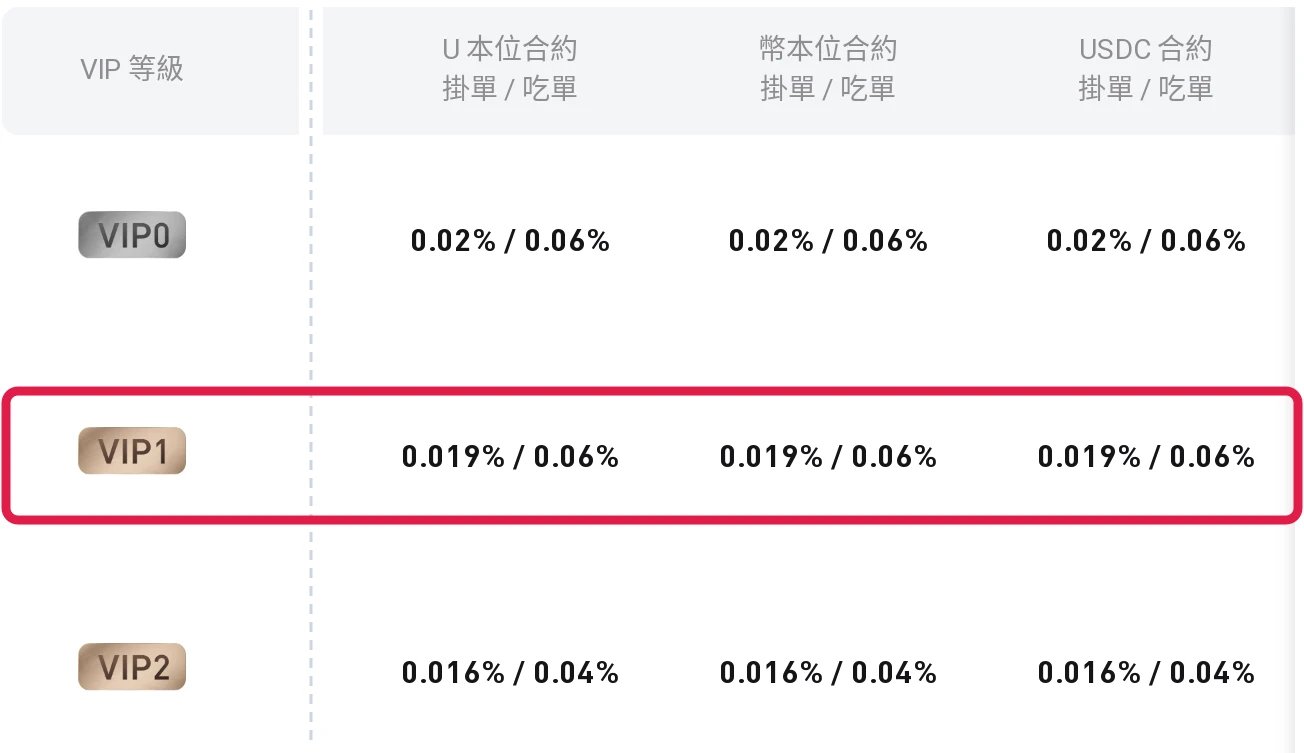 The futures tab of Bitget’s official fee schedule (Traditional Chinese interface, logged out). This site removed the threshold columns in the middle (dashed line) and boxed the VIP 1 row. Screenshot taken on 4 November 2026
This article uses Bitget’s official fee schedule, help center and public API as of 4 and 5 November 2026 to work out where Bitget differs from other exchanges: why VIP 1 means so much more on spot than on futures, where BGB fee deduction can be used, which of the three routes to VIP costs least, which pairs have no fees, and what USDT withdrawals cost. None of the top-ranking Bitget fee articles I read mentions that futures VIP 1 keeps the same taker fee, and one of them gives VIP 1’s futures taker fee as 0.055%.
This article is a summary of information, not investment advice. The fees here are figures taken from Bitget’s official fee schedule, help center and public API on 4 and 5 November 2026. Bitget’s fee schedule notes that actual rates can vary by region and that your trade records are what count, so check the rates shown in your own account before you trade. This site does not give advice on futures or leveraged trading; futures fees are listed only so readers can compare costs.
Bitget key factsData checked: 2026-10-08
As of 2026-10-08, Bitget's general-user spot taker fee is 0.1% and its futures taker fee is 0.06%; signing up with the invitation code gives a 20% trading fee rebate. Its 2026-09-29 proof of reserves showed BTC 142%, ETH 110%, USDT 107%.
| Item | Details | Source |
|---|---|---|
| Jason Finance rating | 63 / 100 | rating method |
| Highlights | Disclosed protection fund BTC reserve ratio 142% Sept 2026 hack covered by its protection fund | |
| General-user fees (taker) | Spot 0.1%, futures 0.06% | 2026-10-08 |
| Invitation code fee rebate | 20% trading fee rebate | 2026-10-31 |
| Proof of reserves | 2026-09-29 (monthly): BTC 142%, ETH 110%, USDT 107% | 2026-10-08 |
| Main licences and registrations | El Salvador CNAD licence, South Africa FSCA licence, Mauritius FSC licence, Australia AUSTRAC registration, Argentina CNV registration | source 1 source 2 source 3 source 4 source 5 |
| USDT withdrawals | Cheapest BEP20 0.01 USDT; 6 common networks supported | 2026-11-01 |
| Order book depth (±2%) | BTC/USDT about 10.6M USD, ETH/USDT about 5.7M USD | 2026-10-08 |
Futures: VIP 1 only lowers the maker fee; the taker fee falls from 0.06% to 0.04% at VIP 2
From the futures tab of Bitget’s fee schedule (checked on 5 November 2026, matching the public API), here are the futures fees for the first four levels:
| Level | Maker | Taker | Taker saving vs regular |
|---|---|---|---|
| VIP 0 (regular) | 0.02% | 0.06% | 0 |
| VIP 1 | 0.019% | 0.06% | 0 |
| VIP 2 | 0.016% | 0.04% | 33% |
| VIP 3 | 0.014% | 0.0375% | 37.5% |
- USDT-M, Coin-M and USDC-M futures cost the same: the fee schedule lists the three separately, and the figures are identical at every level.
- Coin-M futures in Classic accounts have been delisted: Bitget announced on 31 August 2026 that 9 Coin-M perpetual futures in Classic accounts, including BTCUSD and ETHUSD, would be delisted at 15:00 (UTC+8) on 17 September, and advised anyone who still wants to trade Coin-M futures to switch to the Unified Account. On 4 November the public API’s list of Coin-M futures was empty. Bitget has not said separately whether Coin-M futures in the Unified Account use the 0.02%/0.06% on the fee schedule.
- Fees are charged on position value, once when you open and once when you close: Bitget’s guide to futures trading fees gives the formula as fee = order value × fee rate. Its example is a taker order for 1 BTC at 60,000, with a fee of 60,000 × 0.06% = 36 USDT. Leverage does not change it.
- BGB deduction does not apply to futures: the futures tab of the fee schedule has no BGB column. Some sites say paying futures fees in BGB brings 0.06% down to 0.048%; that does not match the official fee schedule.
Here is what futures market orders cost per month (in USDT; volume is position value, counting both buys and sells):
| Monthly futures volume | Regular 0.06% | VIP 1 0.06% | 20% fee rebate (0.048%) | VIP 2 0.04% |
|---|---|---|---|---|
| 1,000 | 0.6 | 0.6 | 0.48 | 0.4 |
| 10,000 | 6 | 6 | 4.8 | 4 |
| 100,000 | 60 | 60 | 48 | 40 |
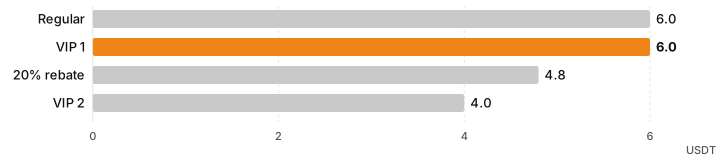
If you trade futures only with market orders, VIP 1 pays exactly what a regular user pays. To lower the futures taker fee, you need either VIP 2 (50,000 USDT in assets or 20,888 BGB) or a fee rebate. If you use limit orders, see “A limit order is not always a maker order” for how to make sure you pay the maker rate.
Spot: VIP 1 drops to 0.08%, and so does BGB deduction
The spot tab of the same fee schedule shows a 20% BGB deduction column for every level:
| Level | Maker/Taker | With BGB deduction (20% off) |
|---|---|---|
| VIP 0 (regular) | 0.1%/0.1% | 0.08%/0.08% |
| VIP 1 | 0.08%/0.08% | 0.064%/0.064% |
| VIP 2 | 0.065%/0.07% | 0.052%/0.056% |
| VIP 3 | 0.05%/0.06% | 0.04%/0.048% |
On spot it is the other way round from futures: VIP 1 cuts the taker fee by 20% straight away. A regular user who switches on BGB deduction pays 0.08%, the same as VIP 1.
You have to switch on BGB deduction, and without enough BGB you pay the full rate
Bitget’s Trading Fees FAQ (20 August 2026) says:
Yes, for spot trading. If you hold BGB in your account and switch on “Use BGB to offset fees” in your Dashboard, your spot trading fee is automatically discounted and deducted from your BGB balance. If your BGB balance is insufficient to cover the fee, the fee reverts to being charged through the original payment method.
- Holding BGB does not give you the discount automatically: you have to switch on “Use BGB to offset fees” first. Some sites say holding BGB gives 20% off with nothing else to do, which is not what Bitget says.
- It comes out of the BGB in your spot account: Bitget’s page on spot trading fees, limits and rules says spot fees are deducted from the available BGB balance in the spot account. It also works for spot margin; Bitget Academy says you need to transfer BGB into your cross margin account.
- It stacks with VIP: the FAQ says “Both can apply at the same time”, and the fee schedule lists the 20%-off rate for every level.
- Go by the fee schedule for the discount rate: the FAQ gives no number and tells readers to check the live fee schedule, which showed 20% on 4 and 5 November.
Take a market order for 1,000 USDT of BTC. A regular user without the deduction pays 1 USDT worth of fees; with it switched on, 0.8 USDT worth is taken in BGB instead, about 0.47 BGB at the 5 November BGB price of about 1.72 USDT. BGB’s price goes up and down; for whether holding BGB to save on fees is worth it, see “Are platform token fee rebates worth it?”.
Spot market orders per month (in USDT):
| Monthly spot volume | Regular 0.1% | BGB deduction 0.08% | VIP 1 0.08% | VIP 1 with BGB deduction 0.064% |
|---|---|---|---|---|
| 1,000 | 1 | 0.8 | 0.8 | 0.64 |
| 10,000 | 10 | 8 | 8 | 6.4 |
| 100,000 | 100 | 80 | 80 | 64 |
Three routes to VIP: volume, assets or holding BGB
Bitget’s VIP levels are not based on volume alone. The fee schedule lists five conditions; meeting any one moves you up, and if you meet several, you get the highest level among them:
| Level | 30-day spot volume | 30-day futures volume | Assets on the day | 30-day average assets | 30-day average BGB held |
|---|---|---|---|---|---|
| VIP 1 | 500,000 | 5,000,000 | 30,000 | 30,000 | 12,533 |
| VIP 2 | 2,000,000 | 10,000,000 | 50,000 | 50,000 | 20,888 |
| VIP 3 | 8,000,000 | 20,000,000 | 250,000 | 250,000 | 104,444 |
(Volume and assets are in USDT. Checked on 5 November 2026.)
Someone trading 100,000 USDT a month is nowhere near the VIP 1 volume threshold, so in practice the routes open to them are assets or BGB.
Assets on a single day count: put in 30,000 USDT and you may move up the next day
The definitions on the fee schedule say that “assets on the day” is the average of snapshots of your account assets taken at 2 random times each day, and that VIP levels update automatically at 09:00 (UTC+8) every day. So you do not have to wait for a 30-day average: 30,000 USDT in assets on one day meets VIP 1.
The flip side is that the level is recalculated every day, so once the assets are moved out, the level should drop back. That is an inference from the rules; Bitget has not published any grace period before a downgrade (Bybit has a 14-day protection rule; see “Bybit fees”).
The BGB threshold: the asset threshold minus 20%, recalculated every two weeks
Bitget’s announcement on VIP BGB threshold updates (17 January 2025, Traditional Chinese) says the BGB thresholds are adjusted dynamically every two weeks, using this formula (translated by this site):
30-day average daily asset balance (USDT) × BGB holding discount coefficient ÷ BGB’s 14-day average daily closing price (UTC+8)
The announcement says the coefficient was first set at 0.8. Working backwards from today’s thresholds, 30,000 × 0.8 ÷ 12,533 and 50,000 × 0.8 ÷ 20,888 both come to about 1.915; in other words, today’s thresholds were calculated with a 14-day average BGB price of about 1.915 USDT and a coefficient of 0.8.
Put simply, reaching VIP by holding BGB takes about 80% of the amount needed under the asset threshold. At the 5 November BGB price of about 1.72 USDT, VIP 1’s 12,533 BGB is worth about 21,600 USDT, and VIP 2’s 20,888 BGB about 35,900 USDT. But BGB’s price moves: if it falls, what you hold is worth less, and two weeks later the threshold is recalculated from the new average price. Sites that say VIP 1 needs 5,098 or 11,526 BGB are quoting earlier thresholds.
Is VIP 1 worth it? The numbers for 10,000 USDT of trading a month
- Spot market orders: VIP 1 saves 2 USDT a month, 24 USDT a year, the same as switching on BGB deduction.
- Futures market orders: VIP 1 saves 0 a month; VIP 2 is needed to save 2 USDT a month.
- The cost: keeping 30,000 USDT on Bitget, or holding about 21,600 USDT worth of BGB. Bitget suffered a hack of about US$388 million in September 2026 (see the Bitget review), so whether to keep a large sum on an exchange to save a few USDT a month is a risk you need to weigh yourself.
At ordinary trading volumes, BGB deduction (on spot) and a fee rebate make more difference; VIP 1 is more something you get along the way if you already keep 30,000 USDT on Bitget.
Only 6 stablecoin pairs have zero fees, and USDC pairs get no discount
Bybit takes 50% off the taker fee on USDC pairs and Binance 5%; Bitget has no such offer. In Bitget’s website pair settings on 4 November 2026, every spot pair was 0.1%, and only 6 stablecoin pairs carried a “0 fees” label:
- USDC/USDT, USDT/USD, USDC/USD
- USDGO/USD, USDGO/USDC, USDGO/USDT
The rules for these pairs:
- They do not count toward VIP volume: the fee schedule says volume on zero-fee pairs is not included.
- No BGB discount and no fee rebate: Bitget’s USDGO listing announcement (3 March 2026) says USDGO/USDT and USDGO/USDC are excluded from the BGB fee discount and from any other fee adjustment or fee offer. I found no similar announcement for USDC/USDT, but with a fee of 0 there is nothing to discount anyway.
So swapping USDT for USDC and then buying BTC on BTC/USDC saves nothing in fees on Bitget: the first step is free and the second is still 0.1%. The only difference is the price on the two pairs. I worked out a 1,000 USDT BTC purchase twice from public market data (fees not included):
| Time (UTC) | BTC/USDT directly | USDC first, then BTC/USDC | Going via USDC |
|---|---|---|---|
| 4 Nov, 17:02 | 0.0124258 BTC | 0.0124246 BTC | about 0.10 USDT less |
| 5 Nov, 16:13 | 0.0131403 BTC | 0.0131448 BTC | about 0.35 USDT more |
The two results went in opposite directions and both were small: what matters is the price gap between the two pairs at that moment, not the fee. For how spreads and slippage affect your fill price, see “Are zero-fee exchanges really cheaper?”.
Two more futures costs: funding and the liquidation fee
- Funding is not a trading fee: the FAQ says funding is exchanged between long and short position holders every 8 hours, with funding fee = position value × funding rate. Not every contract settles every 8 hours, though: of the 872 USDT-M contracts in the public API on 4 November, 494 settled every 8 hours, 377 every 4 hours and 1 every hour; BTCUSDT and ETHUSDT are 8 hours. Go by the settlement interval shown on the trading page.
- A 0.06% liquidation fee rate: Bitget’s guide to liquidation and collateral shortfall risk says the liquidation fee rate for both cross and isolated margin positions is 0.0006, used in calculating the liquidation price. Another Bitget guide says the taker fee needed to close a position is included in the maintenance margin. In other words, this cost still applies when a position is liquidated.
What your own account actually pays: check the fee schedule and your trade history
The fee schedule notes that rates vary by region, and the figures in this article are what a logged-out visitor sees. To check your own rates:
- Your rates: log in and open the fee schedule; your level and rates are shown at the top.
- Whether BGB deduction is on: once it is on, spot fees in your trade history show in BGB; if it is off or you do not have enough BGB, the fee comes out of the coin you traded.
- What each trade cost: the fee in your trade history should equal trade value × your rate.
The 20% fee rebate you get by signing up with an invitation code is returned after the trade, for both spot and futures, so your trade history still shows the original rate; where to see the returned amount, and the records from my own account, are in “Bitget invitation code”. Bitget does not say whether, with BGB deduction on, the rebate is calculated on the amount paid in BGB. The “20% off with BGB, then another 20% off, so you pay 0.064%” calculation you see online is not something Bitget has published, and I have not tested it myself yet.
Bitget is an international exchange. The rate, invitation code and sign-up screenshot in the box below come from data synced daily. Sign up with this site’s invitation code and you get a 20% trading fee rebate, the same for spot and futures:
USDT withdrawals: 2 USDT per ERC20 withdrawal, more than Binance, OKX or Bybit
Bitget charges nothing for deposits; each withdrawal has a fixed fee regardless of the amount. The table below is Bitget’s official data, updated automatically by this site every month:
| Network | Withdrawal fee | Minimum withdrawal |
|---|---|---|
| TRC20 | 1.5 USDT | 5 USDT |
| ERC20 | 2 USDT | 5 USDT |
| BEP20 | 0.01 USDT | 5 USDT |
| Solana | 0.5 USDT | 5 USDT |
| TON | 0.15 USDT | 5 USDT |
| Arbitrum | 0.1 USDT | 5 USDT |
Official public data as of 2026-11-01, updated monthly; the withdrawal page shows the fee that applies. Source · Past changes are in the data update log
Bitget’s official data on 5 November also listed Optimism 0.014, Plasma 0.012, AVAX C-Chain 0.04, Aptos 0.03, Morph 0.03 and Polygon 0.07 USDT (Polygon withdrawals were suspended at the time), with a 5 USDT minimum on every network.
- ERC20 costs more than at the other three: Bitget charges 2 USDT, against 0.6 at Binance, 0.8 at Bybit and 0.24 at OKX in this site’s records. TRC20 is 1.5 USDT, the same as OKX, more than Bybit’s 1.3 and less than the 4 USDT Binance has charged since its hack.
- No change seen since the hack: this site has recorded the fees since 7 October 2026, and up to 5 November the TRC20 and ERC20 withdrawal fees had not changed. This site has no record of the fees before the hack.
- On small withdrawals, the withdrawal fee costs far more than the trading fee: withdrawing 100 USDT over ERC20 costs 2 USDT, or 2%, 20 times the spot fee on 100 USDT; over BEP20 it costs 0.01 USDT. Before picking a network, check that the receiving side supports it; see “How to choose a USDT withdrawal network”.
- The 24-hour withdrawal limit depends on your VIP level: 3,000,000 USDT for regular users; the fee schedule says it is 20,000 USDT for users who have not completed identity verification.
Convert, card purchases and P2P: zero fees, or check the checkout page
- Convert: Bitget’s help pages say Convert has zero fees but that, depending on market conditions, there may be a small spread cost. Bitget publishes no cap on the spread (OKX publishes a 1% cap; see “OKX fees”); quotes refresh every 8 seconds and you have to log in to see them. With no trading fee, there is also nothing to rebate or to pay in BGB (an inference from how the fees are calculated).
- Buying with a card: Bitget’s card purchase guide gives no fixed rate and only reminds you to check “Any fees (e.g., 1.8%)” on the checkout page; 1.8% is Bitget’s own example, not a published rate. The card must be in your name and match your identity verification details.
- P2P: Bitget’s help pages say buyers and sellers on the P2P market pay no fees, though your payment method or bank may charge its own.
Bitget’s proof of reserves, the hack and its licences are covered in the Bitget review. For fee comparisons with other exchanges, see “International crypto exchange fee comparison”, “OKX vs Bitget” and “Bitget vs Bybit”, or work out your own volume with the exchange fee calculator. This site’s invitation code is not for UK or Hong Kong residents. Please follow the laws where you live. More exchange fee guides and reviews are on the crypto topic page.
FAQ
What are Bitget's trading fees?
According to Bitget's official fee schedule (checked on 5 November 2026), regular users (VIP 0) pay 0.1% maker and taker on spot, or 0.08% with BGB fee deduction switched on. USDT-M, Coin-M and USDC-M futures are all 0.02% maker and 0.06% taker. Buying 1,000 USDT of BTC with a market order costs 1 USDT in fees.
Does Bitget VIP 1 lower futures fees?
Only the maker fee. Futures VIP 1 lowers the maker fee from 0.02% to 0.019%, but the taker fee stays at 0.06%, the same as a regular user's. The taker fee only drops, to 0.04%, at VIP 2. Spot is different: VIP 1 lowers both maker and taker from 0.1% to 0.08%.
How much do you save by paying Bitget fees with BGB?
20% on spot (including spot margin): 0.1% becomes 0.08% for regular users, and the fee schedule takes another 20% off every VIP level. It does not apply to futures. The discount is not automatic: you have to switch on "Use BGB to offset fees". If the BGB in your spot account is not enough, the fee is charged the original way at the full rate.
What do you need for Bitget VIP 1?
Any one of these: 500,000 USDT of spot volume in 30 days, 5,000,000 USDT of futures volume in 30 days, 30,000 USDT of assets on the day, a 30-day average of 30,000 USDT in assets, or a 30-day average holding of 12,533 BGB (the threshold on 5 November 2026; it changes every two weeks). Levels update daily at 09:00 (UTC+8).
Are Bitget's USDC pairs cheaper to trade?
No. On Bitget, BTC/USDC is charged the same 0.1% as BTC/USDT; there is no USDC taker discount like Bybit's 50% off. Only 6 stablecoin pairs such as USDC/USDT have zero fees, and their volume does not count toward VIP.
How much does Bitget charge to withdraw USDT?
Deposits are free, and each withdrawal has a fixed fee. Bitget's official data on 5 November 2026: BEP20 0.01 USDT, Arbitrum 0.1 USDT, TRC20 1.5 USDT and ERC20 2 USDT, with a 5 USDT minimum on every network. Go by what the withdrawal page shows.

Comments
Sign in with Google to comment. Your comment will not show your Google profile picture or name; it appears under a randomly generated nickname to protect your privacy.
By signing in you agree to this site's privacy policy.