 Jason Finance
Which BTC Trading Pair Is Cheapest? BTC/USDT vs BTC/USDC Order Books at 7 Exchanges: Fees, Spread, Slippage and Conversion Added Up

On this page
- 1.Holding USDT: buy BTC/USDT directly, or convert to USDC first
- 1.1Why BTC/USDC is quoted about 90 dollars below BTC/USDT
- 2.Already holding that coin: the measured cost of each BTC trading pair
- 3.The conversion step: the USDC/USDT fee and the price gap
- 3.1Bybit: 50% off the taker fee, and no fee to convert
- 3.2Binance: USDC is only 0.005 percentage points cheaper, and a small price gap wipes it out
- 3.3MEXC: 0.05% on BTC/USDT, 0% on BTC/USDC, but a wider BTC/USDC spread
- 3.4OKX, Bitget, KuCoin: no discount on USDC pairs
- 4.Zero fees aren’t the same as cheap: USDe, USD1 and FDUSD pairs
- 5.Bitfinex: zero fees and the lowest total cost in this test
- 6.How the numbers were worked out, and how much the 4 snapshots differed
- 6.1Data sources and method
- 6.2How stable the 4 snapshots were
- 6.3Checking for yourself before you trade
- 7.Invitation codes for the exchanges in this article
- FAQ
The short answer
In 4 snapshots on 8 November 2026, a 10,000 USDT market buy of BTC with USDT cost about 10 USDT on BTC/USDT at large exchanges, almost all of it the 0.1% fee. Only Bybit saved much by switching (4.46 USDT via USDC); MEXC's BTC/USDT fee is already 0.05%. Binance's USDC route varied; OKX and Bitget have no discount; KuCoin also charges 0.1% to convert. Zero-fee Bitfinex: about 0.80 USDT.
Suits
- People who buy BTC with manual market orders on Bybit: 50% off the BTC/USDC taker fee, and no fee to convert USDC/USDT
- People who already hold USDC: BTC/USDC directly at Binance or Bybit
- People buying a few thousand to 10,000 USDT at a large exchange: BTC/USDT spread and slippage are close to zero, so only the fee matters
Doesn't suit
- People converting to USDC at KuCoin to use BTC/USDC: USDC/USDT also charges 0.1%
- People taking the USDC route at OKX or Bitget: no discount, just an extra conversion and a thinner order book
- People switching to USDe or USD1 pairs for zero fees: the spread can cost more than the fee
What would change this verdict
- Bybit ends the 50% taker discount on USDC pairs, or Binance changes its USDC pair promotion
- MEXC changes the BTC/USDT taker fee
- Spreads and order book depth change all the time; this is one morning's snapshots
Disclosure: this page contains exchange invitation links and codes. If you sign up through them, the exchange may pay Jason Finance a referral commission. It does not raise the fees you pay; the invitation fee rebate is set by the exchange. Our ratings follow the published methodology, where the invitation rebate counts only toward the fees item.
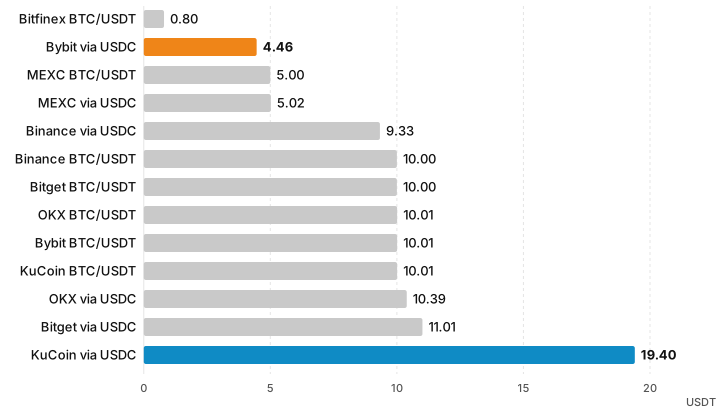
You hold USDT and want to buy 10,000 USDT of BTC with a market order. On the morning of 8 November 2026 I pulled the public order books of 7 exchanges 4 times and added up the fee, spread, slippage and conversion: at Bybit, converting USDT to USDC first and then buying on BTC/USDC cost about 4.46 USDT in total, less than half of buying directly on BTC/USDT (about 10.01 USDT). Taking the same USDC detour at KuCoin cost about 19.40 USDT, because its USDC/USDT pair also charges a 0.1% fee.
Elsewhere the differences were smaller than you might expect. At Binance, OKX, Bitget and KuCoin, the best bid and best ask on BTC/USDT were one tick apart (0.01 or 0.1 USDT), and a 10,000 USDT market order barely reached the second level, so the cost was simply the 0.1% fee. How much BTC trading pairs differ depends mainly on whether the pair has a fee discount, and only then on the thinner order books of USDC pairs. Zero-fee pairs with thin order books, such as MEXC’s BTC/USDE, actually cost more than BTC/USDT with its fee.
This article is a summary of information, not investment advice. The figures come from 4 snapshots taken on 8 November 2026 between 09:04 and 09:36 (Taipei time). Prices, spreads and order books change every minute; these are not quotes and do not represent your cost when you trade. Fees are regular-user (VIP 0) taker rates, which each exchange may adjust by region and account; the order screen and your trade records are what count.
Holding USDT: buy BTC/USDT directly, or convert to USDC first
The table below shows the total cost of a market buy of BTC for someone who only holds USDT. “Via USDC” means first buying USDC with USDT on USDC/USDT (including that step’s fee and spread), then buying BTC on BTC/USDC with the USDC received. Both routes are measured against the same exchange’s BTC/USDT mid price: how much less BTC the same USDT gets you, converted into USDT. Figures are medians of the 4 snapshots, with the lowest and highest in brackets:
| Exchange | 10,000 USDT: direct | 10,000 USDT: via USDC | 1,000 USDT: direct / via USDC | Result of going via USDC |
|---|---|---|---|---|
| Bybit | 10.01 | 4.46 (4.31 to 4.71) | 1.00 / 0.45 | About 5.5 USDT cheaper: 50% off the BTC/USDC taker fee, no conversion fee |
| MEXC | 5.00 | 5.02 (4.95 to 5.05) | 0.50 / 0.38 | Slightly cheaper at 1,000 USDT, about the same at 10,000 |
| Binance | 10.00 | 9.33 (8.94 to 11.83) | 1.00 / 0.93 | Cheaper in 3 of 4 snapshots, more expensive in 1 |
| OKX | 10.01 | 10.39 (10.11 to 10.95) | 1.00 / 0.98 | About 0.4 USDT more on 10,000 USDT |
| Bitget | 10.00 | 11.01 (10.46 to 11.86) | 1.00 / 1.02 | About 1 USDT more |
| KuCoin | 10.01 | 19.40 (18.75 to 20.01) | 1.00 / 1.86 | About 9.4 USDT more: USDC/USDT also charges 0.1% |
| Bitfinex | 0.80 (0.51 to 1.13) | 1.40 (0.78 to 1.60), via BTC/USD | 0.06 / 0.10 | No need to convert: BTC/USDT itself has no fee |
(In USDT. Bitfinex has no BTC/USDC spot pair, so the table uses converting USDT to US dollars and then buying BTC/USD.)
Why BTC/USDC is quoted about 90 dollars below BTC/USDT
At the time of the snapshots, BTC/USDT had a mid price of about 75,790 USDT and BTC/USDC about 75,700 USDC, so BTC/USDC looked about 90 cheaper. The reason is that USDC was slightly more expensive than USDT: the USDC/USDT mid price was about 1.0012 at Binance, OKX, Bybit, Bitget and MEXC, and about 1.00095 at KuCoin. 75,700 USDC times 1.0012 comes back to about 75,790 USDT, so the two pairs priced BTC almost the same.
So you can’t compare pairs by the quote alone. Convert to the same coin, or do as the table above does and work out how much BTC the same USDT gets you. For how USDC and USDT themselves differ (issuers, reserves, depeg history), see “USDT vs USDC”.
Already holding that coin: the measured cost of each BTC trading pair
If you already hold a stablecoin such as USDC or FDUSD, there is nothing to convert; just look up its row below. Total cost = what the average fill price paid above the mid price (half the spread plus slippage) + the taker fee, in the pair’s quote currency, as medians of the 4 snapshots:
| Exchange | Pair | Best bid to best ask | Taker fee | Total cost, buying 1,000 | Total cost, buying 10,000 |
|---|---|---|---|---|---|
| Binance | BTC/USDT | 0.01 | 0.1% | 1.00 | 10.00 |
| Binance | BTC/USDC | 0.01 | 0.095% | 0.95 | 9.50 |
| Binance | BTC/FDUSD | 0.01 | 0.1% (maker 0%) | 1.00 | 10.26 |
| Binance | BTC/USD1 | 3.55 to 7.37 | 0.1% | 1.05 | 11.05 |
| OKX | BTC/USDT | 0.1 | 0.1% | 1.00 | 10.01 |
| OKX | BTC/USDC | 0.1 | 0.1% | 1.00 | 10.63 |
| Bybit | BTC/USDT | 0.1 | 0.1% | 1.00 | 10.01 |
| Bybit | BTC/USDC | 0.1 | 0.05% | 0.50 | 5.01 |
| Bybit | BTC/USD1 | 21.5 to 37.3 | 0.1% | 1.23 | 13.35 |
| Bybit | BTC/USDE | 117 to 166 | 0.1% | 1.87 | 24.25 |
| Bitget | BTC/USDT | 0.01 | 0.1% | 1.00 | 10.00 |
| Bitget | BTC/USDC | 0.01 | 0.1% | 1.00 | 10.79 |
| KuCoin | BTC/USDT | 0.1 | 0.1% | 1.00 | 10.01 |
| KuCoin | BTC/USDC | 0.1 | 0.1% | 1.00 | 10.44 |
| MEXC | BTC/USDT | 0.01 | 0.05% | 0.50 | 5.00 |
| MEXC | BTC/USDC | 16 to 39 | 0% | 0.47 | 5.90 |
| MEXC | BTC/USD1 | 135 to 153 | 0.01% | 1.07 | 10.74 |
| MEXC | BTC/USDE | about 235 | 0% | 1.55 | 15.50 |
| Bitfinex | BTC/USDT | 5 to 12 | 0% | 0.06 | 0.80 |
| Bitfinex | BTC/USD | 5 to 8 | 0% | 0.06 | 0.88 |
Three things stand out in the table:
- At Binance, OKX, Bybit, Bitget and KuCoin, the best bid and best ask on both BTC/USDT and BTC/USDC were one tick apart, so the cost of a 1,000 order was just the fee.
- USDC pairs have thinner order books: buying 10,000, BTC/USDC at OKX, Bitget and KuCoin had to go several levels deep, and the spread plus slippage came to about 0.4 to 0.8 (up to 2.2 in one snapshot), against about 0.01 on the same exchange’s BTC/USDT. Binance’s and Bybit’s BTC/USDC books were deep enough that 10,000 did not reach the second level.
- Pairs such as USDe and USD1 have much wider spreads, which makes them expensive with or without zero fees. The next sections work through them.
For how the spread and slippage affect your fill price and why large orders need to look at depth, see “Are zero-fee exchanges really cheaper?”; this article only looks at the actual figures for a few BTC pairs at the same moment.
The conversion step: the USDC/USDT fee and the price gap
Whether converting to USDC first pays off depends on two things: how much less BTC/USDC charges than BTC/USDT, and how much the USDC/USDT step costs.
Bybit: 50% off the taker fee, and no fee to convert
On 8 November, Bybit’s official spot pair list still tagged BTC/USDC “50% Fees” and USDC/USDT “0 Fees”. This is a discount Bybit introduced in March 2026 for regular users who trade manually (API trades must be under 20% of USDC volume; rules in “Bybit fees”): the taker fee drops from 0.1% to 0.05%.
On a 10,000 USDT purchase, you pay 5 USDT less in fees; USDC/USDT’s best bid and best ask were 0.0001 USDT apart, so the conversion cost about 0.5 USDT more; and at the time of the snapshots BTC/USDC, converted into USDT, was also quoted about 0.008% to 0.012% below BTC/USDT, saving about 1 USDT more. In total, about 5.5 USDT less than buying directly, between 4.31 and 4.71 USDT in all 4 snapshots, the most consistent saving in this test.
Binance: USDC is only 0.005 percentage points cheaper, and a small price gap wipes it out
Binance’s announcement on its USDC spot and margin taker fee promotion (from 10 April 2024 “until further notice”, checked on 8 November) puts the regular-user taker fee at 0.095%, only 0.5 USDT less than 0.1% on a 10,000 purchase.
Converting on USDC/USDT has no fee, but BTC/USDC and BTC/USDT prices don’t line up exactly at every moment. Converting with the mid prices of the two pairs and USDC/USDT, the gap across the 4 snapshots ranged from −0.006% to +0.023%. In the snapshot with the +0.023% gap, going via USDC cost 11.83 USDT, more than the 10.00 USDT of buying directly; the other 3 came to 8.94 to 9.53 USDT. The 0.5 USDT saved is smaller than this price gap, so the result depends on the moment you trade.
MEXC: 0.05% on BTC/USDT, 0% on BTC/USDC, but a wider BTC/USDC spread
MEXC’s official public API pair data (queried on 8 November) gives BTC/USDT 0% maker and 0.05% taker, BTC/USDC 0% maker and taker, and USDC/USDT 0% as well. MEXC’s zero-fee page says all spot pairs have 0% maker and taker fees, but the comparison table on the same page gives MEXC’s spot taker fee as “0% - 0.05%” and says the actual rate is the one shown on each pair’s trading page. This article uses the API figures.
Switching to USDC saves the 0.05% fee, but BTC/USDC’s best bid and best ask were 16 to 39 USDC apart (about 0.02% to 0.05%), and its order book is thinner. As a result, going via USDC cost about 0.38 USDT on 1,000 USDT, slightly less than the 0.50 USDT of buying directly, and about 5.02 USDT on 10,000 USDT, about the same as the direct 5.00 USDT.
OKX, Bitget, KuCoin: no discount on USDC pairs
- OKX: in OKX’s public API pair data on 8 November, BTC-USDT and BTC-USDC are in the same fee group, and the 31 October fee schedule gives both a 0.1% regular-user taker fee; USDC/USDT is in the stablecoin group with 0% fees (“OKX fees”). The conversion costs nothing, but BTC/USDC is thinner, so 10,000 USDT cost about 0.4 USDT more.
- Bitget: BTC/USDC charges the same 0.1% as BTC/USDT, and USDC/USDT is 0% (“Bitget fees”, checked against the official fee schedule on 4 and 5 November). About 1 USDT more, from BTC/USDC’s thinner order book.
- KuCoin: in KuCoin’s public API pair data on 8 November, BTC-USDT, BTC-USDC and USDC-USDT are all class A with a fee coefficient of 1, which means 0.1% for regular users. The USDT-to-USDC step also charges 0.1%, and with BTC/USDC’s 0.1% you pay the fee twice.
Zero fees aren’t the same as cheap: USDe, USD1 and FDUSD pairs
USDT and USDC aren’t the only stablecoins. Several exchanges also list BTC/USDE, BTC/USD1 and BTC/FDUSD. Some of these have zero fees, but thin order books and wide spreads:
- MEXC BTC/USDE: 0% fee, but in all 4 snapshots the best bid and best ask were about 235 USDE apart (about 0.31%). Buying 10,000 USDE of BTC cost about 15.50 USDE, three times MEXC’s BTC/USDT. Starting from USDT, converting to USDe first and then buying cost about 15.98 USDT.
- Bybit BTC/USDE: 0.1% fee, with best bid and best ask 117 to 166 USDE apart. Buying 10,000 USDE cost about 24.25 USDE, the most expensive pair in this test.
- USD1: Bybit’s BTC/USD1 charges 0.1% with a spread of 21.5 to 37.3, about 13.35 on 10,000; MEXC’s BTC/USD1 charges only 0.01% but has a spread of 135 to 153, about 10.74; Binance’s BTC/USD1 has a spread of 3.55 to 7.37 and charges 0.1%, about 11.05. All three cost more than the same exchange’s BTC/USDT.
- Binance BTC/FDUSD: Binance announced on 15 January 2026 that from 29 January the taker fee on BTC/FDUSD and other pairs would return to the standard rate, leaving only the 0% maker fee (checked on 8 November). A market buy pays 0.1%, the same as BTC/USDT; converting to FDUSD first had a median cost of about 12.35 USDT, more than buying directly. The rules for FDUSD pairs are in “Binance fees”.
Binance also announced a zero-fee promotion on BTC/U in April 2026, running from 17 April to 16 July. I found no announcement extending it, and Binance’s promotional pairs page only loads after a browser check, so BTC/U is not included this time.
Bitfinex: zero fees and the lowest total cost in this test
Bitfinex’s fee page (checked on 8 November) lists both maker and taker fees on spot as “Zero”, and its official zero-fee Q&A says this applies from 17 December 2025. Its BTC/USDT best bid and best ask were 5 to 12 USDT apart, much wider than Binance’s 0.01, but with no fee, buying 10,000 USDT of BTC cost about 0.80 USDT in total (0.51 to 1.13), and 1,000 USDT about 0.06 USDT, the lowest of the 7 exchanges.
Two things to keep in mind:
- Restricted regions: Bitfinex does not serve US citizens and residents or residents of Ontario, Canada, and New York residents cannot trade.
- Other conditions: Bitfinex was hacked in 2016, has been penalized twice by the US CFTC, and has published its reserve wallet addresses only once; all of this is in the “Bitfinex review”. Before switching exchanges to save about 9 USDT per 10,000, look at the security record first.
How the numbers were worked out, and how much the 4 snapshots differed
Data sources and method
- Snapshots: 8 November 2026 at 09:04, 09:16, 09:26 and 09:36 (Taipei time), order books taken from the official public market data APIs of Binance, OKX, Bybit, Bitget, KuCoin, MEXC and Bitfinex (no login, no API keys), with every pair at each exchange fetched within about a second. The raw data and calculation scripts are kept in this site’s research files.
- Cost: the mid price is the average of the best bid and best ask. Walking up the asks from the best ask with 1,000 and 10,000 gives the average fill price; how far the average fill price sits above the mid price is half the spread plus slippage, and the taker fee is added on top.
- Fees: regular-user (VIP 0) taker fees, plus the pair’s own official discount (50% off at Bybit for USDC pairs, 0.095% for USDC pairs at Binance). Sources and check dates are given in each section.
- Not included: invitation-code fee rebates, platform token discounts, VIP levels, and deposit or withdrawal fees. A fee rebate only shrinks the fee part, and a zero-fee pair has nothing to rebate; the rates at each exchange are in “Crypto exchange fee rebates”.
- Limitations: these are 4 snapshots from one morning. Bitfinex’s order book is the version its official API aggregates by price (about one level per US dollar), which can put up to about 0.002% of error into the cost. Gate’s order book was fetched too, but the fee its public API gives for BTC pairs (0.2%) doesn’t match its help center (0.1%), and its fee page needs a login, so it is left out.
How stable the 4 snapshots were
| Item | Range across the 4 snapshots |
|---|---|
| BTC/USDT at Binance, OKX, Bybit, Bitget, KuCoin and MEXC, buying 10,000 | The same every time (10.00 or 10.01; MEXC 5.00) |
| Bybit via USDC, buying 10,000 USDT | 4.31 to 4.71 |
| Binance via USDC, buying 10,000 USDT | 8.94 to 11.83 |
| KuCoin via USDC, buying 10,000 USDT | 18.75 to 20.01 |
| MEXC BTC/USDC, buying 10,000 USDC | 4.27 to 7.98 |
| Bitfinex BTC/USDT, buying 10,000 USDT | 0.51 to 1.13 |
BTC/USDT at the major exchanges barely moved, because the cost is essentially the fixed fee. What moved were pairs with wide spreads and thin books, and detours that depend on two pairs’ prices lining up.
Checking for yourself before you trade
- Look at the tag next to the pair or the fee in the order panel: Bybit shows “50% off Taker fees” next to the pair name, and when the label disappears the discount has ended; at other exchanges, check the fee shown in the order panel.
- Note the best bid and best ask: a pair one tick wide and a pair tens of dollars wide cost very different amounts.
- For large orders, look at the size of the first few levels: how deep you go decides how much slippage you pay.
- Check the trade details after the fill: the gap between the average fill price and the mid price before you ordered, plus the fee, is what that trade actually cost.
If you aren’t in a hurry, a limit order avoids the spread and slippage and is charged the maker rate (Binance’s BTC/FDUSD maker fee is 0%), at the price of possibly not filling. For when a limit order still counts as a taker, see “A limit order is not always a maker order”. For a full comparison of regular-user fees across exchanges, see the “international crypto exchange fee comparison”.
Invitation codes for the exchanges in this article
Below are the invitation codes for the international exchanges (for Chinese-speaking users worldwide) tested in this article; go by the rates in each box. None of the figures above include fee rebates, and zero-fee pairs (such as Bitfinex, or MEXC’s BTC/USDC) have no fee to rebate. This site’s invitation codes are not for residents of the UK or Hong Kong; please follow the law where you live.
More exchange fee guides and reviews are on the crypto topic page.
FAQ
Is it cheaper to buy BTC with BTC/USDT or BTC/USDC?
It depends on the exchange. In 4 snapshots on 8 November 2026, Bybit's BTC/USDC had 50% off the taker fee, so buying 10,000 USDC of BTC cost about 5.01 USDC in total, against about 10.01 USDT on BTC/USDT. Binance's BTC/USDC taker fee is 0.095%, only slightly below 0.1%. At OKX, Bitget and KuCoin, BTC/USDC has no discount and a thinner order book than BTC/USDT, so buying 10,000 cost about 0.4 to 0.8 more.
If I hold USDT, does converting to USDC first make buying BTC cheaper?
Only when BTC/USDC has a discount and USDC/USDT has no fee. In the snapshots, converting to USDC first at Bybit cost about 4.46 USDT on a 10,000 USDT purchase, against about 10.01 USDT buying directly; at KuCoin, USDC/USDT also charges 0.1%, so the detour cost about 19.40 USDT. At Binance the USDC route had a median of about 9.33 USDT, but one of the 4 snapshots came to 11.83 USDT, more than buying directly.
Why is the BTC/USDC price lower than BTC/USDT?
Because 1 USDC does not buy exactly 1 USDT. At the time of the snapshots, the USDC/USDT mid price at Binance, OKX, Bybit, Bitget and MEXC was about 1.0012, so BTC/USDC was quoted about 0.12% lower. Converted back into USDT, the two pairs priced BTC almost the same; BTC/USDC was not actually cheaper.
Is a zero-fee trading pair always the cheapest?
No. MEXC's BTC/USDE has a 0% fee, but in the snapshots the best bid and best ask were about 235 USDE apart (about 0.31%), so buying 10,000 USDE of BTC cost about 15.50 USDE, three times MEXC's BTC/USDT (0.05% taker fee). Zero fees only remove the fee; you still pay the spread and slippage.
How can I tell how much spread and slippage I paid on an order?
Before you place the order, note the best bid and best ask and work out the mid price. After it fills, check the average fill price and fee in the order's trade details. The gap between the average fill price and the mid price is the spread plus slippage; add the fee and you have the total cost of that trade.

Comments
Sign in with Google to comment. Your comment will not show your Google profile picture or name; it appears under a randomly generated nickname to protect your privacy.
By signing in you agree to this site's privacy policy.