 Jason Finance
Stop Investing Blindly: 10 Principles of Index Investing for Steady Wealth. Market-Cap Index Funds vs Active Funds, Notes on a 清流君 Video with Supporting Data
The 10 principles of index investing, from low costs and no stock picking to global diversification and rebalancing, plus index funds vs active funds.
On this page
- 1.How market-cap index funds, active funds and picking your own stocks differ
- 1.1Market-cap funds and passive investing
- 1.2Active funds
- 1.3Picking your own stocks
- 2.Cost and risk: principles 1–2
- 2.1Low cost: the power of compounding and the drag of fees
- 2.2Take only market risk, which is rewarded: diversify single-stock risk
- 3.What to buy: principles 3–4
- 3.1Don’t pick stocks: market returns come from a handful of companies
- 3.2Invest in benchmark indexes: the yardstick for the market
- 4.How to buy and hold: principles 5–7
- 4.1Don’t time the market: predicting it rarely works
- 4.2Buy and hold for the long term: time is compounding’s friend
- 4.3Invest spare money when you have it: watch the whole portfolio compound
- 5.How to allocate and stay the course: principles 8–10
- 5.1Diversify globally; don’t bet on one market
- 5.2Asset allocation and rebalancing: the biggest driver of returns
- 5.3Stay the course: get past emotions and think long term
- 6.Conclusion: why active funds rarely beat index investing
- FAQ
Many people chase hot stocks and tips and end up losing money. I used to wonder whether there was a simpler, more effective way to take part in the market and earn a reasonable return. The answer I found was index investing.
The core idea of index investing (market-cap index funds) is to earn the market’s average return. “Average” may not sound exciting, but in investing, average is often excellent.
The short answer: index investing is not just buying any ETF. To earn the market return you need to stick to ten principles together: keep costs low, diversify away single-stock risk, don’t pick stocks, buy benchmark indexes, don’t time the market, hold for the long term, invest spare money when you have it, diversify globally, set an asset allocation and rebalance, and keep going. Drop a few of them and blindly accumulating ETFs can still lose money.
This post was first published in March 2025, and its figures are as of that time. It is a summary of investing principles and my own notes, not personalized investment advice.
Look at the history. Taiwan’s 0050 ETF returned 956.57% including dividends from its 2003 launch, about 11.8% a year (source: Lipper, as of 31 December 2024, compiled by Yuanta Funds). US$100,000 put into VTI, the U.S. total-market ETF, at its 2001 launch had grown to more than US$500,000 by the time I wrote this in March 2025, an annual return above 8%. Through the global financial crisis, trade wars, the pandemic and rate hikes, index investing kept delivering, because when you carry market risk, the market eventually pays you for it.
The ten principles come from a video by 清流君, a Taiwanese YouTuber I really like. I have added data and excerpts from related articles to what he shared.
Tool
Want to know how monthly investing in the U.S. market would have grown in its worst, median and best historical periods? Try my index DCA calculator: enter a monthly amount and see the results.
Try the calculatorHow market-cap index funds, active funds and picking your own stocks differ
Market-cap weighted funds choose and weight holdings by company size, and they are the most common example of passive investing, especially index funds.
Market-cap funds and passive investing
Index funds follow a market index, such as the S&P 500 or Taiwan’s TAIEX, and invest according to the index’s holdings and weights. The managers don’t pick stocks; they copy the index, aiming to match the market. For example:
- Taiwan’s 0050: a classic market-cap, passive fund tracking the 50 largest companies by market value listed on the Taiwan Stock Exchange.
- S&P 500 index funds: track the 500 largest U.S. companies, weighted by market value.
- NASDAQ-100 index funds: invest in the 100 largest non-financial companies on the Nasdaq exchange.
Because these funds don’t need to pick stocks or time the market, their management fees are low.
Active funds
Active fund managers pick stocks based on their own research and market analysis, trying to beat the market. Research, analysis and stock picking all cost money, so fees are higher.
Picking your own stocks
Picking your own stocks has the same goal as an active fund, beating the market, except that you do the research and choose the stocks yourself. Its features and challenges:
- Your own analysis and choices: stocks chosen by your strategy, fundamental analysis (financial statements, industry outlook) or technical analysis (price trends, charts), often concentrated in industries you know.
- Long or short term: sometimes holding growth stocks for years, sometimes trading short term to profit from price swings.
- Risk and return: individuals can’t research and allocate resources as thoroughly as fund managers, so results vary widely. Pick right and you may earn excess returns; pick wrong and you lose money.
- Emotions and behavioral biases: overconfidence and overtrading easily hurt returns.
- Information gaps and time: individuals usually lack institutional research resources, and following companies and industries takes a lot of time.
My own view: I can spend less than 3 hours a day, or even a week, researching stocks. Against professionals who spend 8 hours or more a day with industry information and research resources behind them, I think they have the edge in picking stocks.
I’m not telling anyone to buy active funds, though. My conclusion is to embrace index investing (market-cap index funds). Once I fully understood the logic behind a strategy, it became much easier to stick with it through rough markets.
“Confidence comes from thorough understanding.”
Cost and risk: principles 1–2
Low cost: the power of compounding and the drag of fees
Fees quietly eat into returns. Suppose the market returns 6% a year: US$100,000 grows to about US$430,000 in 25 years. Pay an extra 2% a year in costs and the same investment ends up at only about US$260,000. That small-looking 2% adds up over time to the equivalent of a 40% crash, wiping out about US$170,000.
Nobel laureate William F. Sharpe has pointed out that managers of actively managed mutual funds study trends, research firms and invest based on their reading of the market; some do well and some fall far below the market, but overall their funds average out to the same return as the market.
So before costs, the average active and passive investor must earn the same return, and after costs, the average active investor must earn less than the average passive investor. Passive investing captures the market return at very low cost, so it naturally beats most active investors who pay more.
Further reading: Nobel Laureate Sharpe: There Are No Shortcuts in Investing
Excerpt: “Managers of actively-managed mutual funds study trends, research firms, and invest based on their reading of the market. Some will have good returns, some even better, and some will fall far below the performance of the market at large. Overall their funds will average out to the same return as the market, he said.”
Take only market risk, which is rewarded: diversify single-stock risk
Every stock carries two kinds of risk: market risk and single-stock risk. Market risk is systematic and affects the whole market, as in the global financial crisis; single-stock risk is specific to one company, where a single event can send the price swinging and even wipe out the market’s return. To earn the market return, diversify single-stock risk away.
The method is simple: invest in many companies whose prices don’t move in perfect step, and single-stock risk and portfolio volatility drop. Besides single-market funds like 0050, there are globally diversified market-cap ETFs that hold close to ten thousand companies worldwide, bringing single-stock risk close to zero. What remains is market risk, the kind that is rewarded, and of course you only get the market’s average return.
What to buy: principles 3–4
Don’t pick stocks: market returns come from a handful of companies
Many retail investors love researching individual stocks and believe deep fundamental analysis controls risk, but that is often an illusion. What controls risk is how the portfolio is built, not whether you research individual stocks. And most stock-picking strategies struggle to beat the market consistently, because the market’s overall return comes from a tiny group (about 1%) of the best-performing companies.
A study of global stock markets found that more than 60% of companies lost investors money, and most individual stocks did worse than cash or deposits. It is more extreme than the 80/20 rule, closer to a 99/1 rule: picking stocks is likely to lose money with only a small chance of a big win, and missing that crucial 1% of companies leaves you behind the index.
Unless you are a stock picker like Warren Buffett, carrying a lot of single-stock risk isn’t wise. John Bogle, the father of the index fund, said: “Don’t look for the needle in the haystack. Just buy the haystack!” Buy the whole market and you won’t miss any big winner, with lower risk and without a crowd of mediocre companies dragging down your returns.
Invest in benchmark indexes: the yardstick for the market
A benchmark index measures the whole market. Its key features are market-cap weighting and closely tracking the market. To see how Taiwan’s stock market did, look at the TAIEX total return index; for U.S. large caps, look at the S&P 500 or the CRSP US Total Market Index.
The opposite is a strategy index, such as high-dividend, low-volatility or ESG indexes, which aims for the return of a particular stock-selection strategy rather than the market return. In Taiwan, many retail investors don’t actually hold benchmark indexes but strategy indexes like high-dividend ones that may lag the market average.
How to buy and hold: principles 5–7
Don’t time the market: predicting it rarely works
Trying to predict when to get in and out is usually futile. Research shows that almost every stock trading strategy returns less than the market, and strategies based on technical analysis or financial news do worst. The market’s future often goes beyond past experience, so you can’t forecast it by driving with the rear-view mirror.
Research also finds that U.S. funds’ overall annual returns are higher than what their investors actually earn, and the gap comes from investors trying to predict the market, buying high and selling low. Investors tend to be overconfident and think they can buy low and sell high, and it often backfires.
Buy and hold for the long term: time is compounding’s friend
The long-term market return is what you get by holding continuously, without dodging any decline or missing any rise.
VTI has returned about 8% a year since launch. To capture all of it you need discipline and the stomach for repeated declines of different sizes. The market swings hard in the short run, but holding longer greatly reduces the chance of a loss and narrows the range of outcomes.
Research shows that missing just a few of the market’s best days sharply reduces total return. Many in-and-out strategies that look like they buy low and sell high end up, when tested, holding too much cash or waiting too long, missing key bull runs and earning far less than buying and holding.
Further reading: The Importance of Time, and Other Lessons I’ve Learned at Morningstar
A passage I agree with: “The stock market is seen as a risky investment if you look at it for the short term. Data have shown proof that long-term returns have outsized short-term fluctuations and have triumphed over the risk of missing the one best month on an annual return by betting in and out. In practice, trying to call the trough and the peak of the market prices is distinctly tricky. The strategy involves a great deal of knowledge and luck.”
Invest spare money when you have it: watch the whole portfolio compound
What matters is total return, the compounding of your whole account, not one small sum shooting up. Betting a small part of your money on a single stock has limited effect on the whole portfolio even if it does well, and it may still trail the market.
Index investing is about putting long-term money into the market. Vanguard’s research finds that over the long run a lump sum is more likely to beat cost averaging. So if you have spare money meant for the long term, investing it at once is often the better choice; for investors with lower risk tolerance, investing in stages can reduce the risk of abandoning the plan after a big drop. Looking back, the market has kept reaching new highs over the long run, and the key is to get in early and stay in.
Money waiting to be invested has an opportunity cost too; I put numbers on it in Where to park idle USD and USDT.
Further reading: Vanguard’s article Lump-sum investing versus cost averaging: Which is better? and the research paper Cost averaging: Invest now or temporarily hold your cash?
Excerpt: “We find that LS tends to outperform CA, highlighting how a cash allocation reflects the opportunity cost of lost risk premium,” said Megan Finlay … “But for some risk-averse investors, a CA approach may be more suitable, because it reduces the risk of drawdown or even abandoning their investment plan altogether because they fear large losses.”
How to allocate and stay the course: principles 8–10
Diversify globally; don’t bet on one market
Markets often show mean reversion, and concentrating in one market, such as only U.S. or only Taiwan stocks, is dangerous. An S&P 500 investment made in 2000 was at a loss ten years later, while emerging markets did very well over the same period. Global diversification can raise returns while lowering risk, and even with today’s highly correlated markets, it is still very effective at avoiding permanent damage from one country’s long underperformance.
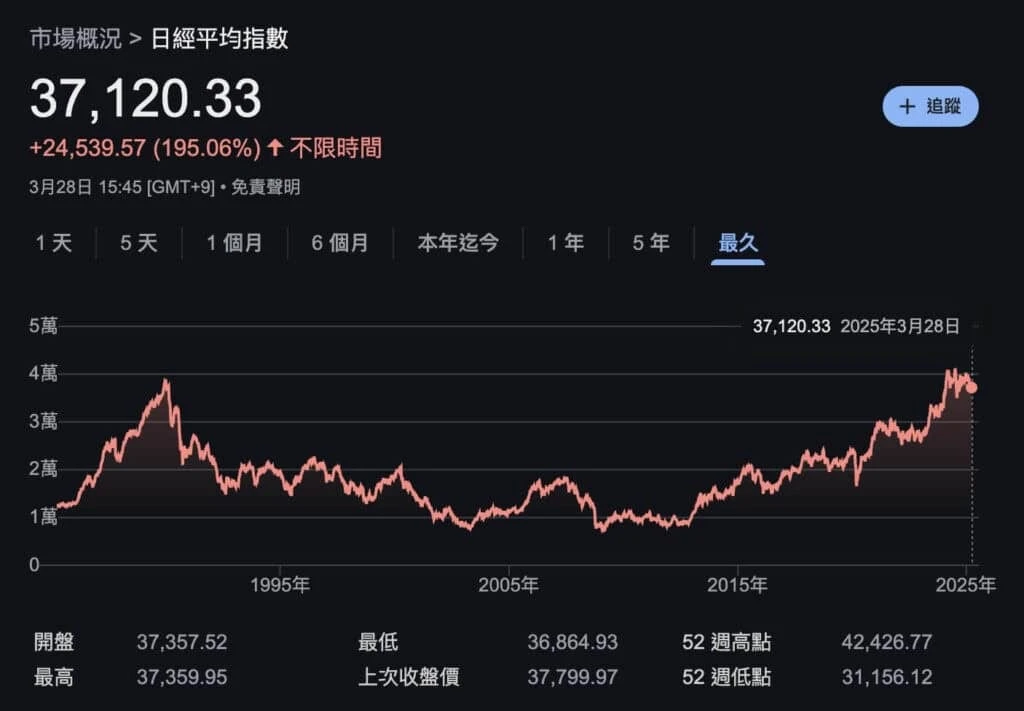
The Nikkei 225 peaked around 1990 and only broke that high in 2024.
Take Japan: the Nikkei 225 hit a high around 1990 and took more than thirty years, until 2024, to break it. Not every country’s market index has a long track record like the S&P 500’s, so diversifying globally instead of betting on one market matters a great deal.
Asset allocation and rebalancing: the biggest driver of returns
Vanguard’s research finds that over the long run, stock picking and market timing explain less than 9% of the variation in returns, while asset allocation explains as much as 91%. Nobody truly controls the outcome of stock picking and timing, but asset allocation is the one factor we control that significantly affects return and risk. A sensible allocation brings smaller swings, shorter stretches under water, better risk-adjusted returns and smaller drawdowns.
You also need to rebalance regularly, bringing the portfolio back to its target weights to control risk. A fixed asset allocation plus rebalancing is the fundamental difference between index investing and blindly accumulating ETFs or dividend stocks.
Stay the course: get past emotions and think long term
Index investing is easy to describe and hard to do, because emotions often win over reason. It takes firm conviction that the market will take care of us over a long time, even when short-term results are poor. That conviction comes from thoroughly understanding index investing.
Index investing is often paired with a stock-bond allocation. Adding bonds lowers total return but also lowers volatility; stocks and bonds often move in complementary ways, which makes it easier to stick with the plan when markets crash. I’ll share my thoughts on choosing a stock-bond mix in a later post.
Conclusion: why active funds rarely beat index investing
Index investing isn’t a shortcut to getting rich overnight. It is a strategy for earning the market return steadily by holding for the long term, diversifying risk and keeping costs low. Understanding and following these ten principles helps us avoid the traps of blind investing and get past our own weaknesses.
As William Sharpe said, active funds as a group perform about the same as the market and, after fees, usually fail to beat passive funds, for three reasons. Active funds carry higher management and trading costs, while passive funds trade little, don’t pick stocks and cost less. Over the long run most active funds can’t keep beating the market, and with high fees their final returns are often below passive funds. And under the efficient market hypothesis (EMH), most market information is already reflected in prices, so trying to beat the market through stock picking or timing usually doesn’t work.
FAQ
What is index investing?
Index investing is a passive approach that tracks a market index through market-cap index funds or ETFs, without picking stocks or timing the market, to earn the market's average return at very low cost.
How do market-cap index funds differ from active funds?
Market-cap index funds copy the index's holdings and don't pick stocks, so fees are low; active funds have managers who pick stocks to try to beat the market, and fees are higher. As William Sharpe put it, before costs the average active and passive returns are equal, and after costs the average active investor must lag.
Is a lump sum or investing in stages better?
Vanguard's research finds that over the long run a lump sum is more likely to beat cost averaging; for investors with lower risk tolerance, investing in stages can reduce the risk of abandoning the plan after a big drop.
Why diversify globally instead of only investing in U.S. or Taiwan stocks?
A single market can underperform for a long time. Japan's Nikkei 225 peaked around 1990 and only broke that high more than thirty years later, in 2024. Global diversification avoids permanent damage from a single country.
Are high-dividend ETFs index investing?
High-dividend, low-volatility and ESG indexes are strategy indexes. They aim for the return of a particular stock-selection strategy, not the market return of a benchmark index, and may lag the market average.

Jason
Account Manager in Google Large Customer Sales and Columbia MBA admit, sharing the money tools and experience he actually uses.
Comments
Sign in with Google to comment. Your comment will not show your Google profile picture or name; it appears under a randomly generated nickname to protect your privacy.
By signing in you agree to this site's privacy policy.