 Jason Finance
Applying to the Claude Startups Program: How I Used AI to Write My Applications, with 4 Prompt Templates and Both Approved Applications
Claude Startups Program application notes: I used Claude to apply for OfferLand and Jason Career and both were approved. My process, prompts and the full texts.
On this page
- 1.What the Claude Startups Program is and what it offers
- 2.My Claude Startups Program result: suspended, re-reviewed, then formally approved two days later
- 3.First, understand what the form is asking
- 4.Five keys to writing the application
- 4.11. “Using AI to improve the experience” says nothing
- 4.22. Tie your unique assets to Claude
- 4.33. Separate “developing with Claude” from “using Claude in your product”
- 4.44. State your mission, but connect it to a specific pain point
- 4.55. Honesty is safer than padding
- 5.My writing process in 5 steps
- 5.1Step 1: gather material before you start writing
- 5.2Step 2: make it complete first, then make it concise
- 5.3Step 3: count characters with code, not by eye
- 5.4Step 4: check for wording traps
- 5.5Step 5: check consistency across documents
- 6.Prompt templates you can use right away
- 6.1Template A: writing your first application
- 6.2Template B: reusing existing documents
- 6.3Template C: cutting to the character limit
- 6.4Template D: asking the AI to find weaknesses
- 7.The two approved applications in full
- 7.1OfferLand: a study-abroad community platform
- 7.2Jason Career: a career education brand
- 8.Checklist before you submit
- FAQ
In October 2026, I used Claude to fill in Anthropic’s Claude Startups Program application for two of my brands, OfferLand and Jason Career, and both were approved. This post covers how I reasoned while writing them: what reviewers are probably looking for, how to tell whether a sentence is any good, and prompt templates you can copy as they are. At the end are the two approved applications in full.
The short version: every sentence should answer one of three questions: who you are, what Claude does in your product, and what will happen once you get the resources. Tie the data or audience that only you have to a specific use of Claude, and report numbers and progress truthfully. What I have active now is 5 Premium seats on Claude Team, plus $1,000 in Claude API credits.
This is a record of my own applications. It is not official Anthropic guidance, and following it does not guarantee approval. The program details and benefits reflect the website as I checked it on 12 October 2026 and may change at any time; check the official website before you apply.
What the Claude Startups Program is and what it offers
Based on the website and its FAQ (checked 12 October 2026):
| Item | What the website says |
|---|---|
| Who can apply | Bootstrapped, pre-seed and venture-backed startups can all apply; venture funding is not required |
| How to apply | Sign in to the Claude Console and fill in the application form |
| Startup Stack | Discounts and credits from partner companies that build their products with Claude, which the website puts at up to about $45,000; redeemed with codes in the Claude Console |
| Support | Book virtual office hours with Anthropic’s Applied AI team, and join startup events, hackathons and the community |
| API rate limit | Members who receive credits through the program get higher API rate limits automatically |
| Where credits can be used | Only on the first-party Claude API in the Claude Console, not on third-party platforms such as AWS Bedrock or Google Cloud Vertex AI |
| Partner VCs | Startups backed by VCs in Anthropic’s partner network may separately receive up to $100,000 in API credits through their VC |
If you apply now, you may not get the same benefits I did. When I checked on 12 October 2026, the website FAQ said the program had received hundreds of thousands of applications over the past few days and that Claude Team and the $1,000 in API credits were currently oversubscribed. People who had already claimed them are not affected. Anthropic also said it would adjust the program and re-review all applications, and the status of some applications may change. Existing members can still use the Startup Stack, office hours and events. My application went through that re-review: the benefits were suspended first, and two days later it was formally approved with Claude Team and $1,000 in API credits (details in the next section).
My Claude Startups Program result: suspended, re-reviewed, then formally approved two days later
I submitted during the days with the most applications. Here is how it went:
- Applications submitted and approved: I submitted one for OfferLand and one for Jason Career.
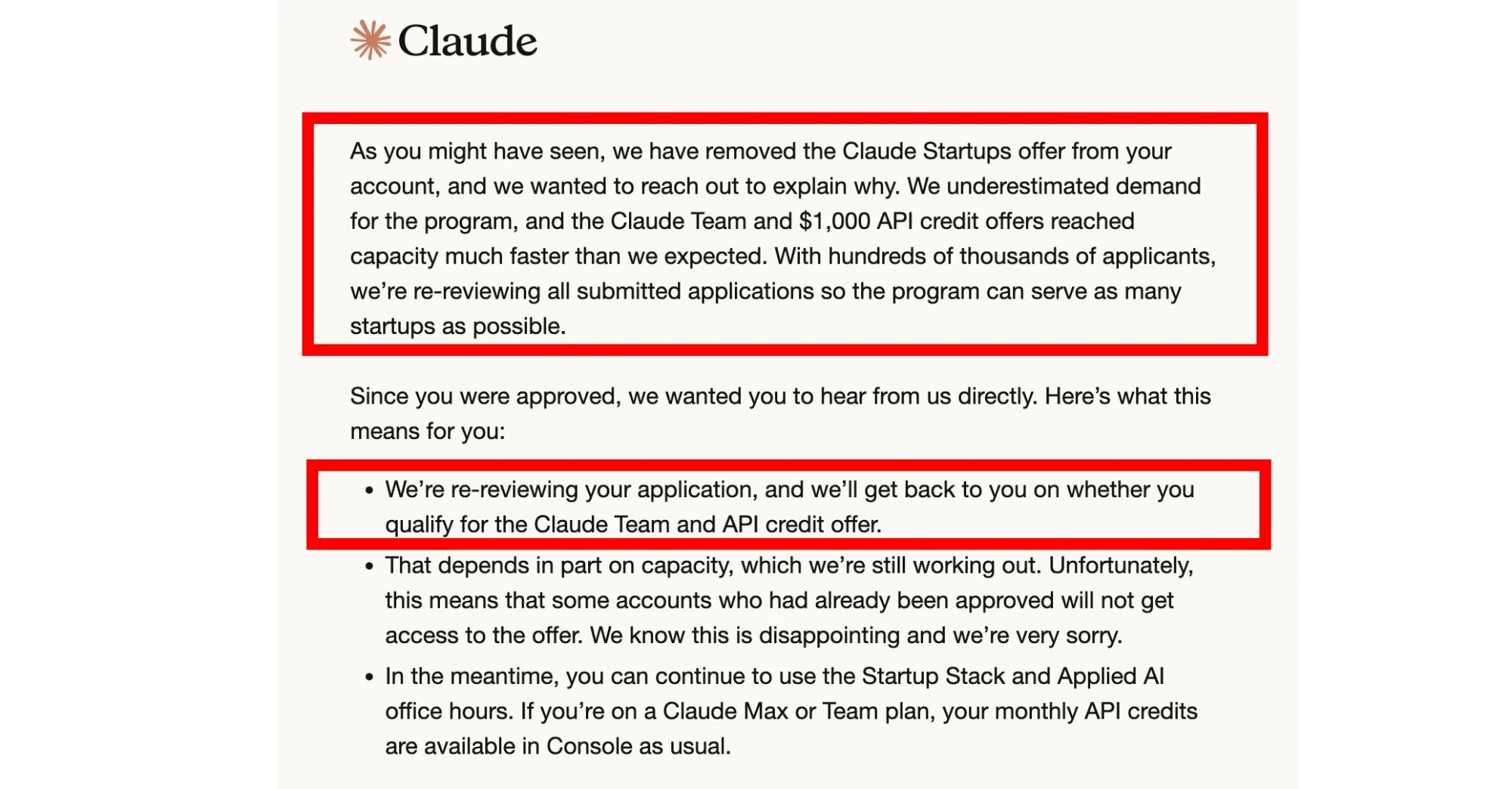
- Benefits suspended and re-reviewed: Anthropic emailed to say it had underestimated the number of applications. It removed the Claude Startups benefits from accounts for now, would re-review every application, and would then let applicants know whether they qualified for Claude Team and API credits.
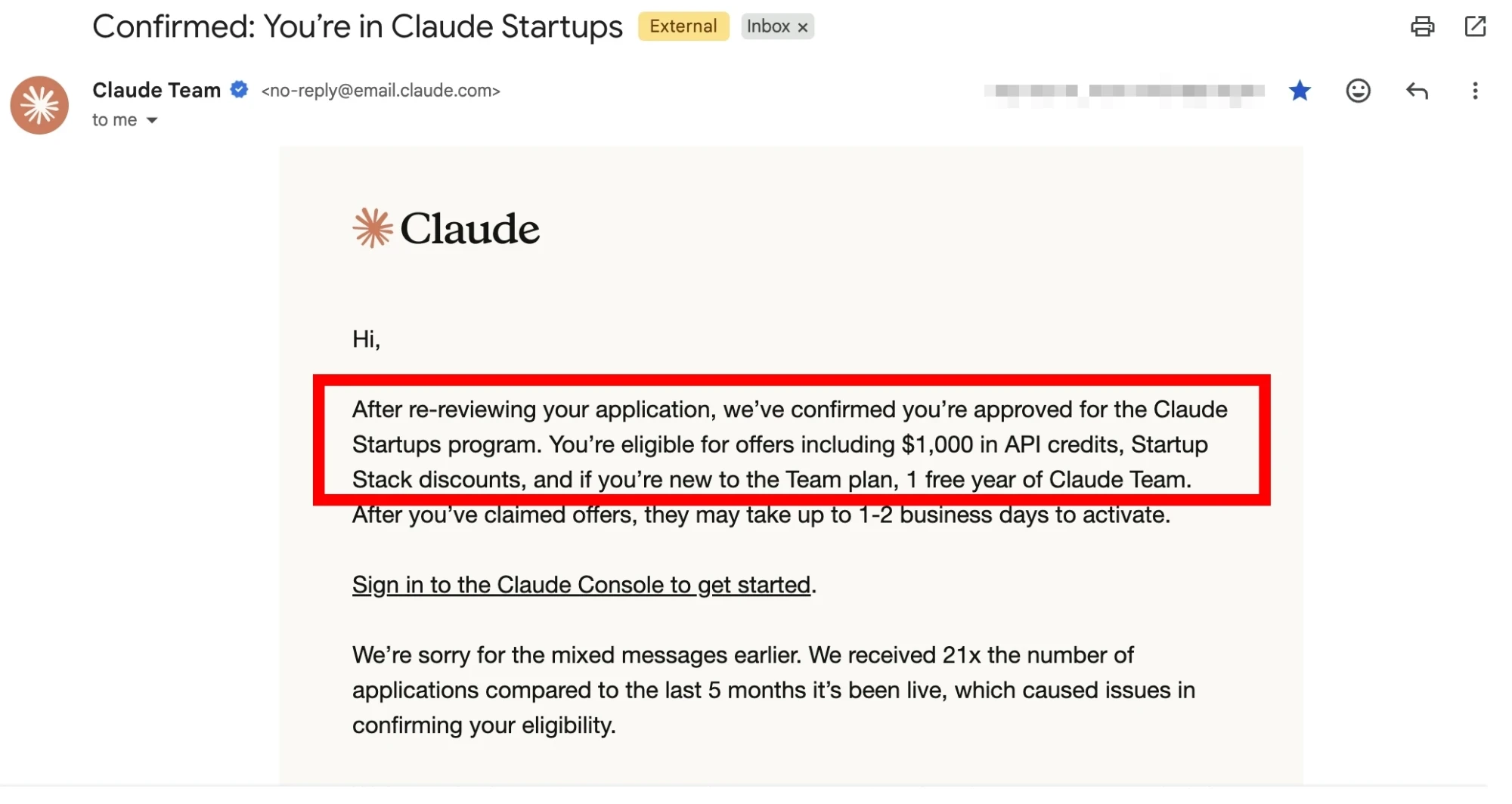
- Formal confirmation two days later: after the re-review, my approval was confirmed. The email listed the benefits I could claim: $1,000 in API credits, Startup Stack discounts, and, for those newly joining a Team plan, a free year of Claude Team. Activation takes up to 1 to 2 business days after claiming.
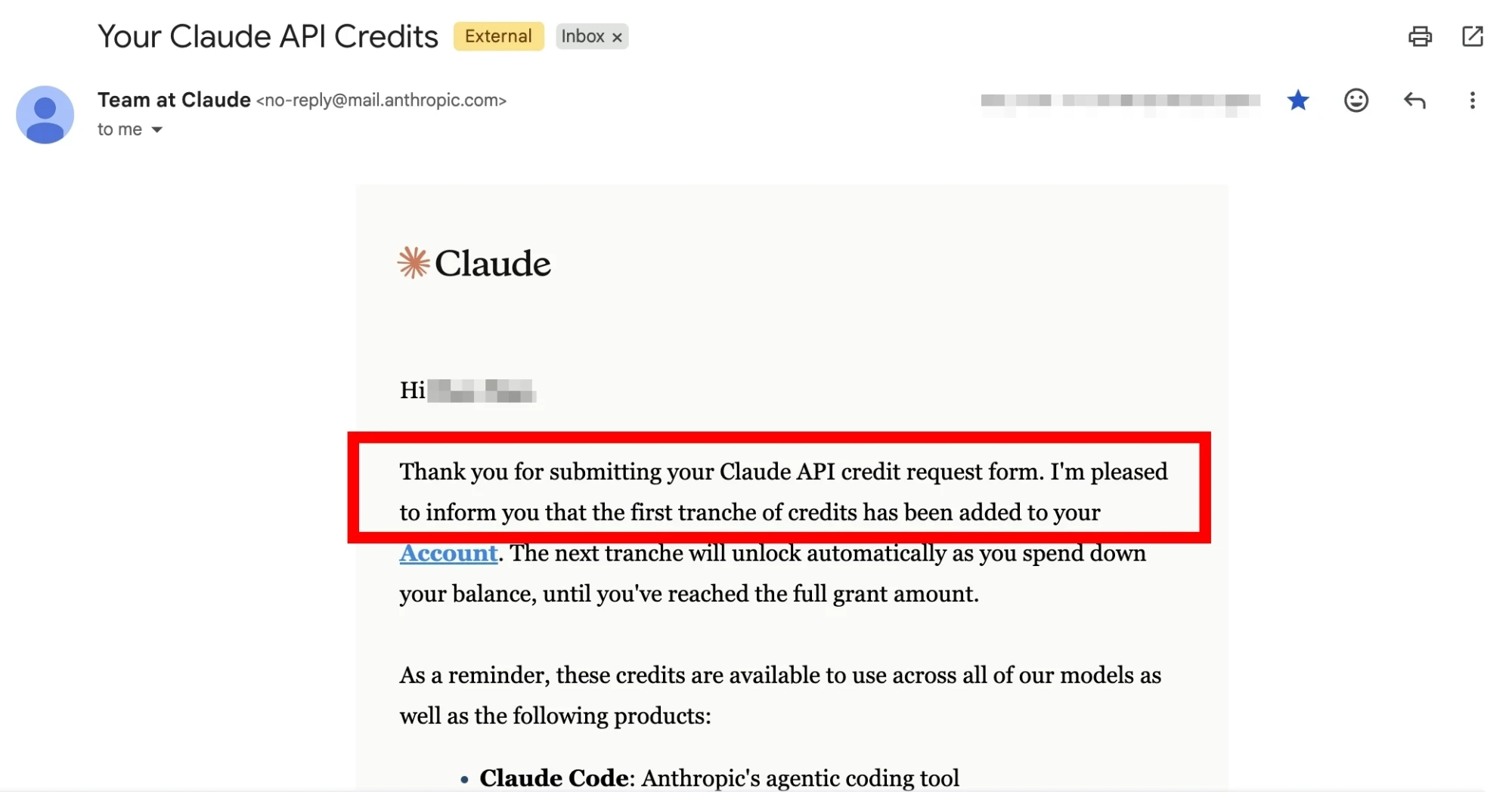
- API credits arrive in batches: the first batch of credits is added to the account first, and once it is used up the next batch unlocks automatically, until the full amount has been added.
What is active now is 5 Premium seats on the Claude Team plan, plus $1,000 in Claude API credits. At Claude’s official pricing, a Premium seat billed monthly costs $125 per seat per month, so 5 seats come to roughly $625 a month.
First, understand what the form is asking
The Claude Startups Program form looks like it has only a few questions:
- What are you building on Claude?
- Where do you want support from Anthropic?
- What % of your monthly AI spend is currently on Anthropic?
- (API version) How will you use the Claude API?, whether you will use it outside Taiwan, and whether it is for internal or external customers
Broken down, I think reviewers want to know three things:
- Who are you, and what have you built? (credibility)
- What does Claude do in your product? (relevance)
- What will happen once you get the resources? (return on investment)
Every sentence should answer one of these. Delete any sentence that does not.
Five keys to writing the application
1. “Using AI to improve the experience” says nothing
Reviewers read a lot of applications every day, and a sentence like “We use AI to enhance user experience” is easy to skip.
The test: swap AI for Excel. If the sentence still makes sense, it is filler.
| Vague | Specific |
|---|---|
| We use AI to help students apply abroad. | Claude reasons over 5,600+ comparable admission results to suggest reach / target / safety schools. |
| AI-powered career guidance. | Students role-play realistic work scenarios, then reflect with Claude on fit with their interests and values. |
The specific versions have three parts: what data goes in → what reasoning Claude does → what result the user gets.
2. Tie your unique assets to Claude
Anyone can say “I want to build a chatbot with Claude.” What you need to answer is: why you?
The answer is usually something you have that others do not:
- Community data, such as 12,000 members, more than 5,600 real admission results, or a bank of more than 800 interview questions
- An audience, such as 32,000 Instagram followers
- Expertise, such as a consulting methodology or a coaching framework
The formula: your unique asset + Claude = a feature no one else can build.
3. Separate “developing with Claude” from “using Claude in your product”
This is where people get confused most often:
- Using Claude Code to rewrite your website: a development tool, so it plays a supporting role.
- Product features that call the Claude API: this is the lead role in “building on Claude.”
You can mention both, but get the weighting right. Make Claude in your product the main thread and give Claude Code one line, for example “using Claude Code to rebuild our site so a small team ships fast”. For how I use Claude Code to build a website myself, see Building a Website Without Reading Code.
4. State your mission, but connect it to a specific pain point
A mission like “Disrupt the agency industry” or “democratize career exploration” is fine to include, but it has to be connected to a specific pain point:
Students in Asia routinely pay agencies thousands of dollars for school selection… often based on opaque, outdated information.
Start with the pain point, then the mission, and finally how Claude solves it. A mission without a pain point reads like a slogan.
5. Honesty is safer than padding
- Pick your AI spend % truthfully. 0% is fine, as long as your answer to the first question makes clear that you are about to start building on Claude.
- Only use numbers you can back up. “500+ positive reviews” is not “500+ clients”, and padded numbers fall apart as soon as someone asks a follow-up question.
- Do not overstate your progress. If you are still planning, write prototyping, not we’ve built.
My writing process in 5 steps
Step 1: gather material before you start writing
The more real the material you give the AI, the better the result. Here is what I do:
- Give Claude the website URL to read (product features, data, endorsements).
- Add other documents you have already written, such as an MBA essay, a pitch deck or a fundraising presentation.
- Add plans that are not on the website, such as “we plan to rebuild the site with Claude Code.”
If you have written an MBA essay, a job description or an investor presentation, be sure to include it. These documents usually already contain the “why” you have thought through, and the AI can reuse your wording so the story is consistent across everything you send out.
Step 2: make it complete first, then make it concise
Ignore the length limit in the first draft and get everything that needs saying down. Once the content is right, compress it.
Step 3: count characters with code, not by eye
The fields I ran into had a 500-character limit. Have the AI actually count the characters (including spaces) with code; do not trust its estimate of “about 500 characters.”
The order for cutting:
- Delete repeated adjectives first.
- Then turn bullet lists into a single sentence.
- Only then cut secondary information, such as internal uses.
- Never cut the data or the specific uses of Claude.
Step 4: check for wording traps
Examples I actually caught:
- Backed by vs. Selected by: being selected for an incubator is not the same as being invested in, and writing “backed” can be misread as having taken money.
- We’re building vs. We’re prototyping: this has to match your actual progress.
Step 5: check consistency across documents
When you are applying for several things at once (for example an MBA, an accelerator and the Startups Program), the timeline for the same product has to match across documents.
For example, an MBA essay describes a long-term goal after graduation, while the Startups application says “we are building it now.” The two do not necessarily conflict, but have a one-sentence explanation ready, such as “we are validating a prototype with our existing audience first, and the MBA is about scaling it.”
Also, if one person has several brands, position them separately. Of my two brands, one focuses on study-abroad applications and the other on career simulation, and the applications must not look like the same product applying twice.
Prompt templates you can use right away
Template A: writing your first application
I'm applying to Anthropic's Claude Startups Program. Please help me write the application in English.

[Company information]
- Company name: [ ]
- Website: [URL] (please read it first)
- Other links: [IG / LinkedIn / product page]

[Key data] (real numbers only)
- Number of users / members: [ ]
- Revenue, paying users, growth rate: [ ]
- Awards, incubators, endorsements: [ ]

[What we're doing on Claude]
- Features already live: [ ]
- Features being planned: [ ]
- Whether we develop with Claude Code: [ ]

[Mission]
- The industry problem we want to solve: [ ]

[Form questions] (paste the original text, including character limits)
[ ]

Requirements:
1. Every sentence must be specific. No filler like "AI-powered" or "enhance experience"
2. Tie our unique data or audience to specific uses of Claude
3. Only use the numbers I give you. Don't make any up
4. When you're done, count the characters with code and confirm they fit the limits
5. Point out where I need to add real information
Template B: reusing existing documents
Attached is my [MBA essay / pitch deck / business plan].
Please find the vision, pain points and wording related to [product name],
and rewrite them as Claude Startups Program application content,
so the two documents tell a consistent story.

If the two documents contradict each other on timeline or progress (for example, one says "we will build it" and the other says "we're building it"),
point it out directly and suggest how to make the wording consistent.
Template C: cutting to the character limit
Cut this to [500] characters or fewer (including spaces).
Keep first: data, specific uses of Claude, the mission.
Cut first: repeated descriptions, secondary internal uses.
Count the characters with code, and tell me the final count and what you cut.
Template D: asking the AI to find weaknesses
Read this application from the point of view of an Anthropic reviewer and tell me directly:
1. Which sentence is the vaguest, the one a reviewer would skip?
2. Which number or claim could be misunderstood, or wouldn't hold up to a follow-up question?
3. What's missing that should be there?
Don't be polite. Just say it.
The two approved applications in full
OfferLand: a study-abroad community platform
Starting material: the website had more than 12,000 members, more than 5,600 admission records and a bank of 802 interview questions, and OfferLand had been selected by Taiwan Startup Hub and NTU TEC, but Claude appeared nowhere on the website.
My call: the biggest risk was that the connection to Claude was invisible, so I mapped each existing asset to a Claude feature: admission data to admission-chance analysis, and the interview question bank to mock interviews.
Final version (457 characters):
OfferLand is Taiwan's largest study-abroad community: 12k+ members, 5,600+ real admission results, 800+ interview reports. We're using AI to disrupt the opaque, costly agency industry and make admissions info open to every student. On Claude, we're building data-grounded admission-chance analysis, mock interviews, and essay feedback, and using Claude Code to rebuild our site's UI/UX so a small team ships fast. Selected by Taiwan Startup Hub and NTU TEC.Jason Career: a career education brand
Starting material: 32,000 Instagram followers, ebooks and consulting services, plus an MBA essay laying out a long-term vision for an “AI career simulation platform.”
My call: the strongest argument in the essay was that “the simulation is not the end point; the reflection afterwards is what matters,” which is exactly where Claude is strong, so I put “reflect with Claude” at the core.
Final version (494 characters):
ElevenTwentyFive runs Jason Career, a leading Taiwanese career education brand (32k Instagram followers). We're building an AI career simulation platform on Claude: students try realistic work scenarios across professions, then reflect with Claude on fit with their interests and values before committing years to a path. Many students never get internships, networks, or firsthand exposure to explore careers. We want to make that exploration accessible to everyone and reduce career mismatch.The Support field: instead of generic technical support, I wrote down what is genuinely hard about this product:
1. API credits to prototype and test career simulations with our 32k-follower community before scaling.
2. Applied AI guidance on designing realistic, multi-turn role-play scenarios, keeping feedback consistent and grounded in our coaching frameworks, and evaluating whether simulations actually help users make better career decisions.
3. Connections with other education and career founders building on Claude.
Being able to name the technical challenges of your own product shows you have thought it through, and it also gives reviewers a better idea of how they can help.
Checklist before you submit
- Every sentence passes the “swap AI for Excel” test
- At least one unique asset is tied to a Claude feature
- Claude’s use inside the product plays the lead; development tools play a supporting role
- Every number has a source and none are padded
- Progress descriptions (built, building, prototyping) match reality
- Character counts have been confirmed with code
- Wording is consistent with your other external documents (MBA, pitch deck)
- Multiple brands do not overlap in positioning
- AI spend % is filled in truthfully
The biggest value of using AI to write an application is not that it makes your writing look good. It is that it forces you to make vague ideas specific. When the AI asks you “Is this feature already live?” or “Is this number customers or positive reviews?”, those are the same questions a reviewer will be asking in their head.
Give it plenty of real material first, then let the AI help you compress and find the holes. Get that order right and your application will not be bad.
For more on how I run websites with Claude Code, see Jason Finance from Zero to One and Running WordPress Without Knowing SSH. All posts are on the AI Startup topic page.
FAQ
What is the Claude Startups Program?
It is Anthropic's program for startups, and you apply through the Claude Console. The website lists discounts and credits from partner companies (the Startup Stack, which the website puts at up to about $45,000), virtual office hours with Anthropic's Applied AI team, and startup events. The website states that bootstrapped, pre-seed and venture-backed startups can all apply, so you do not need venture funding.
Can I still get Claude Team and $1,000 in API credits if I apply now?
Possibly not. When I checked on 12 October 2026, the website FAQ said applications had far exceeded expectations and that Claude Team and the $1,000 in API credits were currently oversubscribed. People who had already claimed them are not affected, and Anthropic also said it would re-review all applications. My application went through that re-review, and two days later it was formally approved with Claude Team and $1,000 in API credits. Check the website's latest information before you apply.
Can Claude Startups Program API credits be used on AWS Bedrock or Google Vertex AI?
No. The website FAQ states that the program's credits can only be used on the first-party Claude API in the Claude Console, not on AWS Bedrock, Google Cloud Vertex AI or other third-party platforms.
How should I write the application to improve my chances?
My approach is to make every sentence answer one of three questions: who you are and what you have built; what Claude does in your product; and what will happen once you get the resources. If a sentence still makes sense after you swap AI for Excel, it is filler. Report numbers and progress truthfully. This is how I write, and it does not represent Anthropic's review criteria.
What was the outcome of my applications?
In October 2026, both the OfferLand and Jason Career applications were approved. Along the way, the benefits were briefly suspended and re-reviewed because of the volume of applications, and I received formal confirmation two days later. What is active now is 5 Premium seats on Claude Team (at the official monthly price of $125 per seat, roughly $625 a month) and $1,000 in Claude API credits, which arrive in batches.
Related articles
- Building a Website Without Reading Code: How I Built Jason Finance Cheaply with Claude Code + GitHub + Cloudflare, and What It CostsI can't read code. Jason Finance runs on Claude Code, GitHub, Cloudflare Workers and Supabase free plans. The setup, costs, AI permissions and limits.
- Git Can Push, but Claude Code Can't Read GitHub Issues: SSH vs GitHub API PermissionsClaude Code can't read GitHub Issues but git push works? SSH keys only cover Git. Sign in with gh CLI, check scope, protect the token, go from Issue to PR.
- Running Multiple Claude Code Remote Controls on One Server: Linux Users, systemd and git worktreeMultiple Claude Code Remote Controls on one server: Linux users by trust, one systemd service each, git worktree for dev vs writing, --spawn=worktree limits.

Jason
Account Manager in Google Large Customer Sales and Columbia MBA admit, sharing the money tools and experience he actually uses.
Comments
Sign in with Google to comment. Your comment will not show your Google profile picture or name; it appears under a randomly generated nickname to protect your privacy.
By signing in you agree to this site's privacy policy.