 Jason Finance
Getting a China CITIC Bank Marriott Credit Card as a Taiwanese in Beijing: Applying From Outside the Mainland, the Deposit Condition, and Whether the Annual Fee Is Worth It
A Taiwanese in Beijing gets a China CITIC Bank Marriott card: most branches said no, one wanted RMB 200,000 in assets for 3 months. Fees, free nights, status.

On this page
- 1.Why it’s hard for Taiwanese to get a credit card in mainland China
- 2.How my application went: many branches, and finally a RMB 200,000 asset condition
- 3.The three China CITIC Bank Marriott cards
- 4.How to get the free nights and status
- 5.Why it’s called a “positive-return card”
- 6.Don’t confuse it with the Marriott card in Taiwan
- 7.For Taiwanese working in mainland China: a checklist before you apply
- FAQ
I’m Taiwanese and I work in Beijing. As a loyal Marriott member, I applied for the 精逸白金卡 (“Platinum Card”) of the China CITIC Bank (中信银行) Marriott Bonvoy co-branded credit card. The annual fee is RMB 980, and the free night and elite status it gives each year add up to more than the fee, which makes it what mainland cardholders call a “positive-return card” (正收益卡). For a Taiwanese, though, the hard part isn’t choosing the card. It’s getting approved. I already had proof of employment in Beijing and paid tax normally, yet I asked many branches and only one was willing to issue it, on the condition that I hold total assets of RMB 200,000 at that bank for a full three months.
The short answer: in mainland China, Taiwanese fall under what banks call “persons from outside the mainland” (境外人员). Even if you work and pay tax there, getting a credit card is much harder, so ask several branches. As for the card itself, China CITIC Bank’s published terms say that once you pay the annual fee you get a free night, Marriott Gold Elite status and elite night credits every year, which pays off for people who stay at Marriott often. The asset condition I ran into, however, was the branch’s own requirement. It is not published officially and may differ by branch and by person.
This post is based on my own application and on public information from China CITIC Bank, Marriott and the Chinese government that I checked on 17 October 2026. Credit card terms change; the bank’s current announcements take precedence. This post is not financial advice.
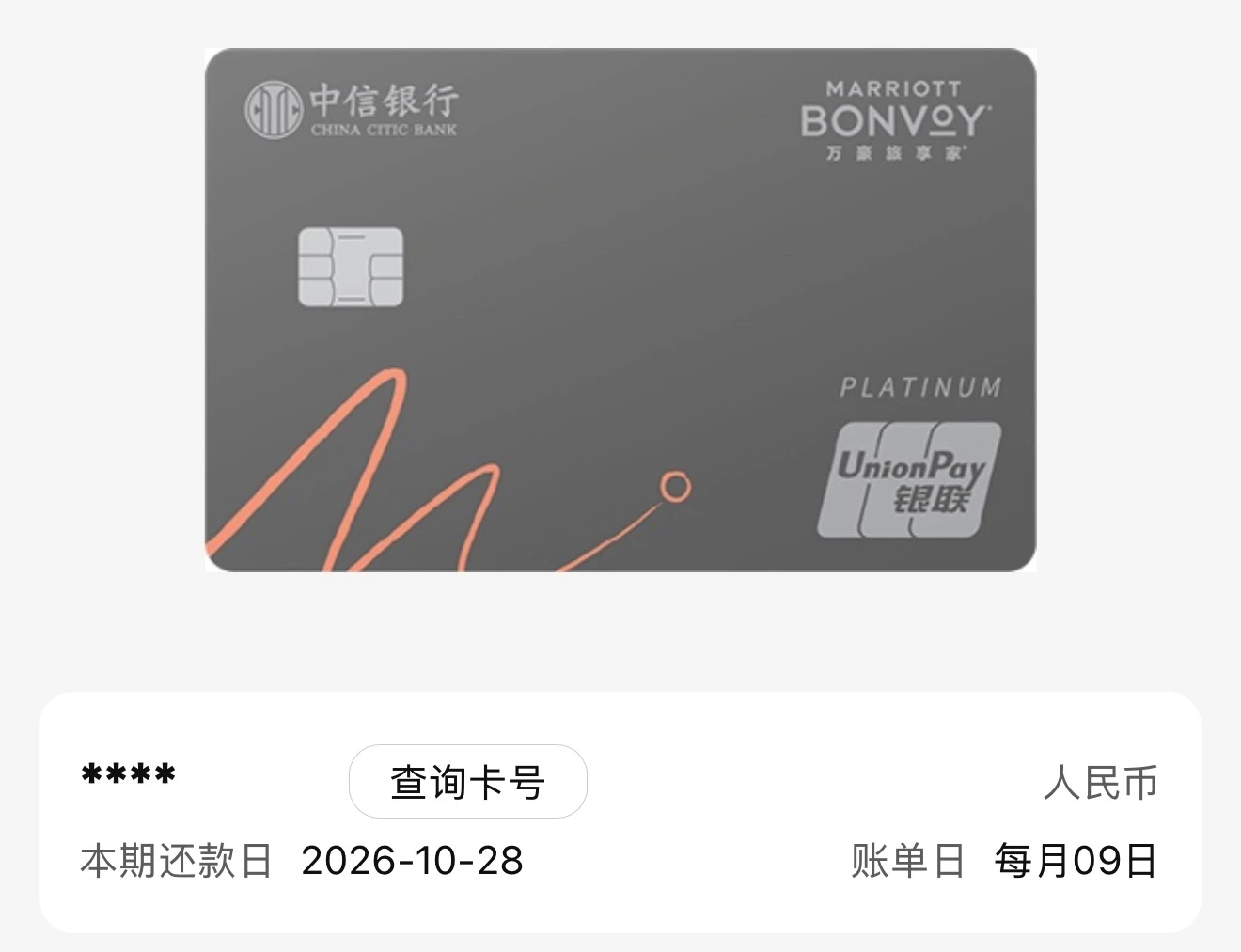 My China CITIC Bank Marriott co-branded Platinum Card (card number masked)
Why it’s hard for Taiwanese to get a credit card in mainland China
To mainland banks, Taiwanese are “persons from outside the mainland.” When I applied, I already had proof of employment in Beijing and a normal tax record, yet I was often turned away at the branch, and many branches simply said they couldn’t do it.
Under the official rules, Taiwanese are not barred from applying:
- A residence permit can be used for financial services: Article 13 of the State Council’s 2018 Measures for the Application and Issuance of Residence Permits for Hong Kong, Macao and Taiwan Residents states that residence permit holders can use banking, insurance, securities, futures and other financial services. To apply for the permit, you must have lived in the mainland for half a year and have one of the following: a lawful and stable job, a lawful and stable residence, or continuous enrollment in school.
- The employment permit for Taiwan, Hong Kong and Macao residents has been abolished: the Ministry of Human Resources and Social Security explained in 2018 that after the employment permit was abolished, Taiwan residents can prove employment with a residence permit or a Mainland Travel Permit for Taiwan Residents (台胞证), together with a labor contract, business license or social insurance record.
Whether a card is approved, though, is up to each bank’s own review. The only explanation for applicants from outside the mainland that I could find on China CITIC Bank’s website is an old Q&A from April 2018. It still asks for the abolished employment permit for Hong Kong, Macao and Taiwan residents, plus one of three: proof of property ownership in the mainland, a good credit report from the People’s Bank of China, or proof of a senior position at a large company. That explanation is out of date; to find out what is actually checked now, ask the branch.
How my application went: many branches, and finally a RMB 200,000 asset condition
My approach was to call branches first rather than walk up to the counter. I called many China CITIC Bank branches, and most said they couldn’t do it. In the end, the Beijing Jiaoda sub-branch (北京交大支行) was willing to process my application.
The condition this branch gave me: total assets of RMB 200,000 with China CITIC Bank, held for a full three months. The branch didn’t require a time deposit; it only looked at total assets. I deposited the money at the end of 2025 and chose a time deposit, then applied three months later, in February 2026. Here is the record of the transfer into the time deposit account:
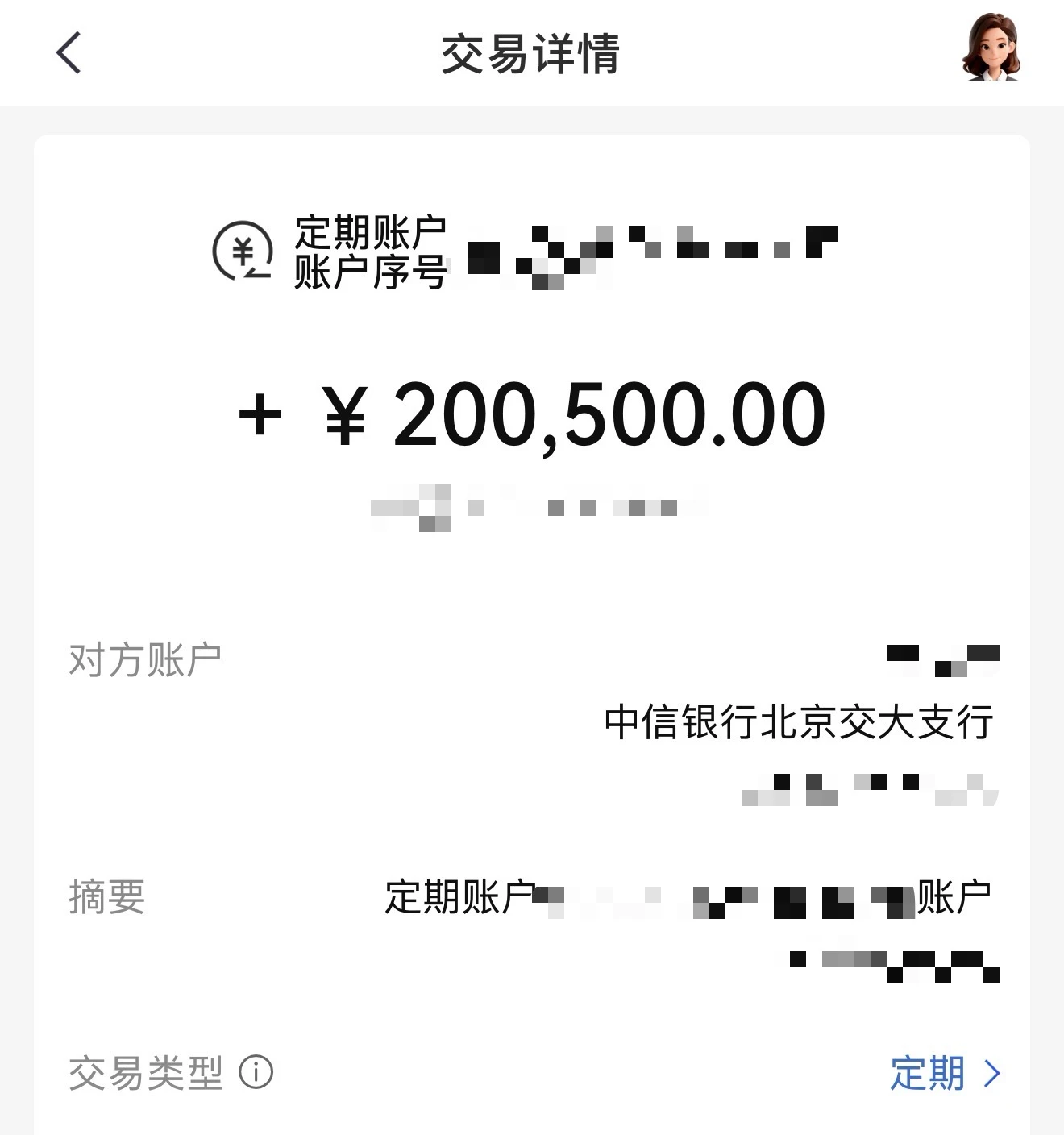 Record of the transfer into a time deposit account at the end of 2025 (account number masked)
A few tips:
- The asset condition came from the branch, not from official rules: neither the terms of China CITIC Bank’s Marriott co-branded card nor its application page lists a deposit as an application requirement. Other branches, at other times, may be completely different.
- Have your documents ready: Mainland Travel Permit for Taiwan Residents, residence permit, proof of employment, tax records, and a real-name-registered mainland mobile number.
- Ask several branches: within the same bank, different branches can treat applicants from outside the mainland very differently.
The three China CITIC Bank Marriott cards
Based on China CITIC Bank’s application page and Marriott China’s co-branded card page:
| Gold Card | Platinum Card (精逸白金卡) | Premium Platinum Card (白金卡) | |
|---|---|---|---|
| Annual fee (RMB) | 200 | 980 | 6,800 |
| Annual fee waiver | First year waived for one purchase or cash withdrawal within 30 days of approval; second year waived for 5 more purchases in the first year | Charged in full, no waiver | Charged in full, no waiver |
| Free nights each year | None | 1 night, redemption value up to 12,500 points | 2 nights, redemption value up to 35,000 points per night |
| Marriott status | Silver | Gold | Gold; upgraded to Platinum with RMB 500,000 in spending in a statement year |
| Elite night credits each year | 5 nights | 10 nights | 15 nights |
| Everyday earning | 1 point per RMB 18 | 1 point per RMB 10 | 1 point per RMB 10 |
| Marriott hotel earning | 2 points per RMB 18 | 2 points per RMB 10 | 3 points per RMB 10 |
| Hotel dining discount | 10% off | 20% off | 20% off |
| Airport and high-speed rail lounges | None | Up to 4 airport or 8 high-speed rail visits a year | Up to 16 airport or 32 high-speed rail visits a year |
Benefits are from China CITIC Bank’s July 2026 terms and conditions; dining discounts and lounges are from the Marriott China page. Also note:
- One extra night on the Premium Platinum Card: with RMB 500,000 in qualifying spending in a statement year, you get 1 more night (up to 35,000 points) and an upgrade to Marriott Platinum Elite status.
- PLATINUM on the card face doesn’t necessarily mean the 白金卡: in the English names in China CITIC Bank’s terms, the 精逸白金卡 is the “Platinum Card” and the 白金卡 is the “Premium Platinum Card.” My card says PLATINUM on the face, and it is the 精逸白金卡.
- This is an RMB card: it is a UnionPay card, and the app shows an RMB account.
How to get the free nights and status
Under China CITIC Bank’s terms:
- Free nights: issued within 4 weeks after the annual fee is charged in each statement year and you pay off the first statement (including the annual fee) before the second statement date. Only the primary cardholder can use them and must be present at check-in. They are valid for 12 months after issue, cannot be redeemed with “Points + Cash,” and do not cover resort fees or service charges.
- Topping up points: you can add points to a free night to book a more expensive room. China CITIC Bank’s terms say you can add up to 15,000 points; Marriott’s current program rules say up to 25,000 points. The two don’t match, so Marriott’s rules at the time you redeem take precedence.
- Status: China CITIC Bank’s announcement of 7 April 2025 says that for new cards applied for from 28 May 2025, you must activate the card and make a purchase of RMB 99 or more before status is granted within 4 weeks. I applied in February 2026, so this rule applies to me. On both platinum cards, you must pay the annual fee on time each year to keep Gold Elite status.
- Elite night credits: one Marriott member can receive at most 15 credit card elite night credits a year, no matter how many cards they hold.
Apart from paying the annual fee and paying off the first statement, I found no other spending threshold in the terms for keeping the free night. The RMB 500,000 threshold applies only to the Premium Platinum Card’s third night and Platinum status.
Why it’s called a “positive-return card”
A “positive-return card” is one where the benefits you get back each year are worth more than the annual fee. Marriott doesn’t publish a fixed points redemption chart, and the points price at the same hotel varies by date and room type (Marriott program rules 3.2.e), so there is no official RMB value for a free night.
Here is how I work it out against the Platinum Card’s RMB 980 annual fee:
- The free night covers the fee first: on Marriott’s website, look up the hotel and dates you will actually stay, and compare the cash price and points price for the same night. If a room costing 12,500 points or less a night has a cash price above RMB 980, that 1 night alone covers the annual fee. For a more expensive room, you can top up with points (see the previous section).
- Then add Gold Elite status: the benefits of Marriott Gold Elite status, plus 10 elite night credits a year, have real value for people who stay at Marriott often and want to move up to higher status.
- Other benefits: 20% off dining at Marriott hotels and up to 4 airport or 8 high-speed rail lounge visits a year only count if you use them.
For someone like me who already stays at Marriott often, the math works out. If you don’t stay at Marriott often, you may not use the free night, so it may not be worth it.
Don’t confuse it with the Marriott card in Taiwan
CTBC Bank (中國信託) in Taiwan also has a Marriott Bonvoy co-branded card, but it is a different product with different requirements and benefits. This post covers the RMB credit card issued by China CITIC Bank in mainland China, and applicants need work or residence status in the mainland.
For Taiwanese working in mainland China: a checklist before you apply
- Get a residence permit first: you can apply after living there for half a year with a stable job or residence, and the residence permit can be used for financial services.
- Prepare your documents: Mainland Travel Permit for Taiwan Residents, residence permit, proof of employment, tax records, and a real-name-registered mainland mobile number.
- Call the branch first: ask whether applicants from outside the mainland can apply, what documents are needed, and whether there is a deposit or asset requirement.
- Ask several branches: one branch saying no doesn’t mean the others will.
- Get the asset condition clear: how much, for how long, whether it counts deposits or total assets, and whether you can use the money during that time.
For comparing credit cards and bank accounts in Taiwan, see the cards and banking topic page; for my experience opening a Hong Kong bank account, see “Opening a Hong Kong Bank Account as a Taiwanese.”
FAQ
Can Taiwanese apply for a credit card in mainland China?
You can apply, but each bank decides whether to approve the card. Under the State Council's 2018 Measures for the Application and Issuance of Residence Permits for Hong Kong, Macao and Taiwan Residents, a residence permit holder can use banking and other financial services; China CITIC Bank has not published current application requirements for Taiwan residents. I already had proof of employment in Beijing and a normal tax record, and I still had to ask many branches before I found one willing to issue the card.
How many China CITIC Bank Marriott cards are there, and what are the annual fees?
According to China CITIC Bank's application page, there are three: the Gold Card (RMB 200, first-year fee waived if you use the card once within 30 days of approval), the 精逸白金卡 "Platinum Card" (RMB 980) and the 白金卡 "Premium Platinum Card" (RMB 6,800). The annual fee on both platinum cards is charged in full every year and is not eligible for waiver offers.
Do you need RMB 200,000 in assets to get the card?
Not necessarily. This was the condition the Beijing Jiaoda sub-branch gave me at the time: total assets of RMB 200,000 with China CITIC Bank, held for a full three months, not necessarily in a time deposit. I deposited the money at the end of 2025, put it in a time deposit, and applied in February 2026. China CITIC Bank's official terms and application page do not list assets as an application requirement, and branches may set different requirements for applicants from outside the mainland, so ask the branch directly before you apply.
What does the Platinum Card give you each year?
Under China CITIC Bank's terms, once you pay the annual fee and pay off your first statement before the second statement date, you get 1 free night each year (redemption value up to 12,500 points), plus Marriott Bonvoy Gold Elite status and 10 elite night credits. Everyday spending earns 1 point per RMB 10, and spending at Marriott hotels earns 2 points per RMB 10.
Is this the same as the Marriott co-branded card in Taiwan?
No. This post is about an RMB card issued by China CITIC Bank in mainland China. CTBC Bank in Taiwan also has a Marriott co-branded card; it is a different product with different requirements and benefits.
Related articles
- Opening a Hong Kong Bank Account as a Taiwanese: Standard Chartered and ICBC (Asia) Worked; Where Hang Seng, BOCHK, Citi and Virtual Banks Draw the LineHong Kong bank account as a Taiwanese: I opened at Standard Chartered and ICBC (Asia) with a passport. Hang Seng, BOCHK, Citi and virtual bank rules, fees, tax.
- USD Time Deposit Rates in Taiwan Compared: Bank USD Time and Demand Deposits vs Short-Term Treasury ETFs and USDT EarnUSD time deposit rates in Taiwan, checked 2026-10-12: about 2.00% to 2.10% for 1 to 12 months, 0.45% to 0.60% on demand. Vs Treasury ETFs and USDT earn.
- Opening a Standard Chartered Hong Kong Account as a Taiwanese: Booking, Proof of Funds and DowngradingStandard Chartered Hong Kong account as a Taiwanese: book ahead and avoid wealth centres unless you want Priority, or face HK$1M proof of funds. Fees.

Jason
Account Manager in Google Large Customer Sales and Columbia MBA admit, sharing the money tools and experience he actually uses.
Comments
Sign in with Google to comment. Your comment will not show your Google profile picture or name; it appears under a randomly generated nickname to protect your privacy.
By signing in you agree to this site's privacy policy.